


B2B Digital Selling Strategy: The Complete Overview
Most marketing strategies are written by marketers for marketers. That is the first problem. Search "digital marketing" on Google and you get over a billion results. Everyone has an opinion. Hardly anyone has evidence of it working at scale. It reminds me of the old saying: no one ever got fired for buying IBM. The same dynamic plays out in B2B every day — everyone follows the same playbook, nobody questions whether it works, and the results stay exactly where they have always been.
Every business chases demand generation, marketing automation and Account Based Marketing. But ask about actual results and the room goes quiet. Forrester's research puts it plainly: roughly 1% of marketing-generated leads ever convert to closed revenue. The funnel your CMO built is largely a machine for generating activity with almost no commercial output.
The search for good marketers and good marketing strategies is endless — and the average CMO tenure in the UK and US sits at just eighteen months. Three months to form a plan, twelve months to execute it, three months to prepare an exit. That is not a coincidence. There is not enough varied, engaging content being produced to make a real difference to B2B results. So what does work?
If you believe growth comes from adding headcount, you will stay stuck at roughly £100–150k turnover per person per year. That is the ceiling when you rely on one-to-one selling. To get past it, your approach to digital has to change completely — and that means ditching most of the automation, stopping the cold calling fallback, and taking an open, pressure-free approach that lets prospects come to you at their own pace.

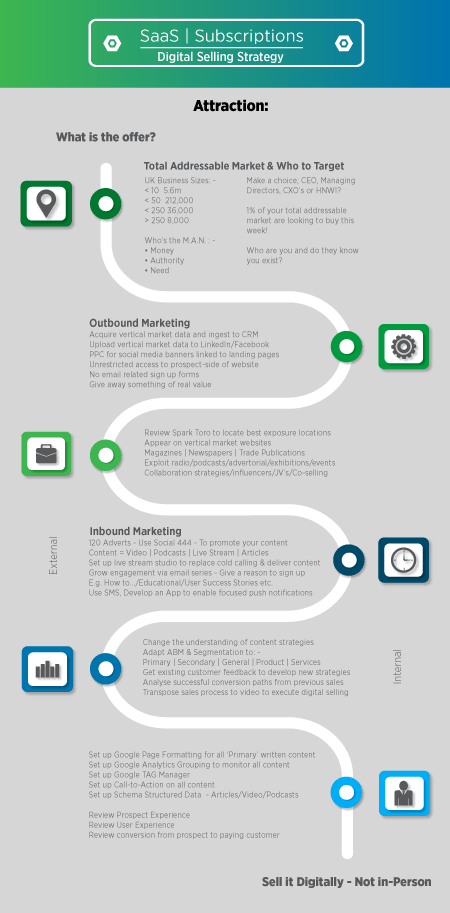
The infographic below outlines the path we follow at salesXchange. There is a second one further down showing how to apply the same thinking to existing customers.
Contents
2. The Digital Selling Strategy
3. Content Creation Connected with SEO
4. The Repeatable Social Media Distribution Strategy
5. Marketing Automation + Permission Marketing
6. Marketing Automation + Outbound Email
7. Marketing Automation + Pay Per Click Banners
8. Marketing Automation + Freemium Product Sign-up
10. Partner & Affiliate Marketing Strategy
11. Direct Engagement Strategy
12. B2C vs B2B Marketing — Don't Confuse the Two
1. The B2B Marketing Problem
B2B marketing produces mediocre results because most businesses fail to create varied, relatable content — articles, downloads, videos, podcasts, live sessions — that lets the prospect choose the format that suits them. Instead, everything gets funnelled through whichever automation platform the last CMO bought.
83% of businesses research digitally before engaging with a company. They want to self-educate, self-serve, and stay anonymous until they are ready. Your job is to be visible and credible during that phase, not to trap them in a form.
The result of ignoring this is a total dependency on software to capture contact details — which then lands on a salesperson to follow up, which brings you straight back to one-to-one selling. That approach stops businesses from scaling. We know from our own research that the average B2B turnover per head sits around £100–150k per annum. That is the cost of staying stuck.
Here are some of the numbers that matter in B2B sales strategy today:
- 80% of all B2B sales interactions now occur via digital channels — Gartner
- 61% of B2B buyers prefer a rep-free buying experience — Gartner (2024)
- 73% of B2B buyers actively avoid suppliers who send irrelevant outreach — Gartner (2024)
- 83% of buyers research digitally before engaging with a salesperson — Gartner
- 95% of buyers on a Day One shortlist purchase from one of those vendors — 6sense (2025)
- Only 1% of marketing-generated leads convert to closed revenue — Forrester
- 20% of businesses fail in year one, 30% by year two, 50% by year three, 91% by year ten
- 500,000 businesses start and close in the UK every year
- ~400 cold calls to find one interested party — our research
- Average CMO tenure in the UK and US is 18 months
- 95% of your market is not actively buying at any given time
- B2C marketing strategies do not translate to B2B — they never have
- Marketing automation platforms were designed to replace cold calling — they just made it digital
- £100–150k turnover per person per annum is the B2B norm — and the ceiling when you rely on headcount
2. The Digital Selling Strategy
Create engaging, multi-format content that lets prospects self-serve at every stage of their evaluation. Give them articles to read, videos to watch, podcasts to listen to. Give them something for wherever they are in their thinking — without demanding their email address to get it.
Achieve market exposure through well-structured content that Google can index, organic and paid posts on social media distributed daily, and banner advertising in your vertical markets. Draw prospects in. Stop hunting them down. Then scale on the back of genuine demand.
The resistance to change in B2B comes down to one thing: everyone wants a tactic that delivers immediate results. That has never existed. What does exist is a structured approach that builds visibility and trust over time, at scale, without the overhead of a large sales team chasing unqualified contacts.
CEOs, CFOs and investment managers all want the same outcome — a profitable, scalable business. The components below are how we get there. Read through them all. Each one connects to the others.
3. Content Creation with SEO
- Write substantive articles in the right Google format — aimed at educating, advising and teaching, not at gaming page rankings
- Create video, podcasts and live-stream programmes covering the same subject areas in different formats
- Structure all content in a non-linear format — meaning prospects can enter at any point, not just the top of a funnel:
- General (Company, staff, community, culture)
- Secondary (Events, PR, news, industry commentary)
- Primary (In-depth guides, downloads, expert opinion)
- Product (Explainers, brochures, FAQs, demos)
- How to Buy (Clear online process, with a call option if needed)
- Use Google Search Console to understand what is performing, not as the goal — appearing on page one is a byproduct of good content, not the strategy itself
- Monitor content via Google Analytics and Tag Manager — edit, improve, or remove based on what the data tells you
- Take a look at our own page SEO for Digital Selling to see the logic we apply and the results we get from it
4. The Repeatable Social Media Distribution Strategy
- Social 444: 4 ads, posted 4 times per day, across 4 weeks — 120 adverts per cycle, then repeat
- 120 adverts covering memes, motion graphics, short video clips and static graphics
- Auto-posted to LinkedIn, Facebook and other relevant platforms where your audience is active
- Adverts promote content in sequence: General > Secondary > Primary > Product > How to Buy
- Use SparkToro to identify exactly which websites, podcasts and social channels your market uses — then advertise there
- Focused, fixed-cost, low-maintenance and fully automated once set up
5. Marketing Automation + Permission Marketing
- When a prospect gives you their email address voluntarily, create content exclusively for subscribers
- Build a 10-part educational series — How to guides, practical advice, useful context
- Include clear calls to action in each email linking back to relevant website content
- No more than two emails per month — stay useful, not intrusive
- Monitor engagement and lead score through your marketing automation platform
6. Marketing Automation + Outbound Email
- Purchase a targeted vertical market email database and/or clean your existing one
- Segment by relevant criteria before sending anything
- Create specific, high-quality content for those recipients — not a generic newsletter
- No more than two emails per month
- Track click-through activity and lead score via your marketing automation platform
7. Marketing Automation + Pay Per Click Banners
- Upload purchased database contacts to LinkedIn, Facebook and other relevant platforms for matched audience targeting
- Select vertical market websites and display multi-format banner ads
- Run A/B/C split tests across verticals, LinkedIn, Facebook and Google
- Implement remarketing via Google and Meta pixel
- All banners point to landing pages that deliver content directly — no email capture forms
- PPC is targeted but cost-sensitive: competitive bidding can inflate costs and click fraud is a real risk
8. Marketing Automation + Freemium Product Sign-up
- Upload contacts to LinkedIn, Facebook and relevant platforms for targeting
- Display banners on relevant vertical market websites
- A/B/C test across all channels to find what converts
- Implement remarketing via Google and Meta pixel
- Banners lead to a landing page with a sign-up form for the freemium product or service
- On sign-up, capture full profile data and segment by vertical and role
- Engagement and follow-up email tracks based on that segmentation
- Apply conversion rate optimisation: test, use heat maps, improve UX and CX, review analytics
- Monitor click activity and lead score via your marketing automation platform
9. Existing Customer Strategy
- Objective: generate case studies, referrals, cross-sell and upsell opportunities
- Create video, photo and live-stream content with and about your customers
- Segment by job title and industry to keep communication relevant
- Stay relatable — keep improving, keep the email tracks engaging
- Monitor activity and lead score through your marketing automation platform
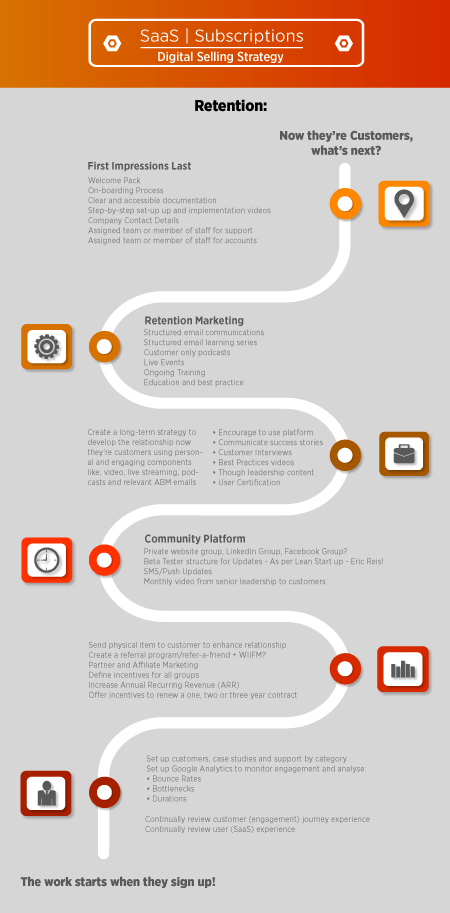
The infographic below shows how to keep existing customers engaged and committed to your support and product plans over time:
10. Partner & Affiliate Marketing Strategy
- Connect with associated, non-competing businesses and industries in adjacent markets
- Set up multi-tier commission structures using platforms such as Post Affiliate Pro, PartnerStack or Impact
- Promote via ClickBank or equivalent platforms where relevant
- Treat partners like your best salespeople — give them excellent support, recognise performance and reward it
- Monitor referral activity and lead score through your marketing automation platform
11. Direct Engagement Strategy
Give prospects and customers the channels they actually use to get in touch. The channel should be their choice, not yours.
- WhatsApp | Facebook Messenger | Telegram | Viber | SMS
- Mobile and web app messaging | MMS | Push notifications
- Google Business Messaging | Live Chat | RCS | Signal
- Video calls | Email | Voice — when the customer asks for it
12. B2C vs B2B — Don't Confuse the Two
We focus entirely on B2B. But since the question comes up often, here is how B2C works — and why you cannot just copy it for a business audience.
B2C content is bite-sized, emotional and identity-driven. It applies storytelling and branding at pace. Formats include:
- Articles | Videos | Memes | Motion graphics | Podcasts | Photos
- The message is always some version of: what is in it for me, you will look good, your life improves
Platforms that drive B2C:
- Google PPC and Shopping Ads
- Remarketing ads
- Banner advertising
- Facebook, Instagram, YouTube, TikTok and X (formerly Twitter) — both ads and organic posts
Conversion in B2C runs through:
- Influencer strategies and YouTube
- eCommerce and shopping cart flows
- Affiliate marketing
SEO and analytics tools commonly used in B2C include Ahrefs, SEMrush and NeilPatel, alongside Google Analytics and attribution modelling. These have a place in B2B SEO too, but the commercial logic is completely different. B2B buyers are not making impulse purchases. They are making considered decisions over months, often with multiple people involved. The emotional triggers that work on consumers do not land the same way with procurement teams and CEOs.
Conclusion
Scaling a B2B business is only achievable through digital engagement — not through adding headcount and expecting revenue to follow. The entire process, from first awareness through to purchase, must be built and refined digitally. Salespeople come into the picture when the customer asks for them. Not before.
The marketing strategies most B2B businesses run are built around the software they bought, not around the actual behaviour of the people they are trying to reach. Big Tech told B2B to buy marketing automation and they did — at enormous cost. It did not change the failure rate. The same number of businesses go bust every year. 500,000 start and 500,000 close in the UK alone, every twelve months. The tools got more sophisticated. The results did not improve.
You do not need Account Based Marketing sitting on top of all this. The approach above is already targeting specific verticals and individuals — that is the point. ABM is what you buy when you have no strategy and someone needs to sell you something.
The components in this article are not a wish list. They are the minimum architecture for a B2B business that wants to grow past the headcount ceiling, reduce its cost of acquisition, and stop being dependent on cold outreach to keep the pipeline moving. Take a look at how we approach digital selling in practice and the difference it makes when it is built properly.
Whether you call yourself an early adopter or a pragmatist, the approach works in parallel to whatever you are currently doing. As the new model builds, the old one becomes unnecessary. The first step is understanding the diagnosis clearly enough to act on it. Our sales articles cover many of the components above in more detail if you want to go deeper on any one area.
Everything in this article points to the same diagnosis: B2B businesses are running GTM models built around what vendors sold them, not around how buyers actually behave. The cold calling, the automation funnels, the ABM layers, the CMO churn — it is all symptoms of the same structural problem. The course works through that problem methodically, from first principles, so you understand exactly what to change and why before you change anything.
The course is 20 modules, CPD certified, built on sales fact and not marketing theory. Most CEOs go through it with their VP of Sales, aligning on the diagnosis together before involving the rest of the GTM team and implementing the new strategy.
Review The Reset Today Nigel Maine is the founder of salesXchange and the architect of the sX Operating System — a B2B commercial framework built from three decades of running technology sales, not from marketing theory.
His work is grounded in a single conviction: that most B2B growth models were designed for consumer buying behaviour and have never been corrected. salesXchange exists to fix that. Nigel works directly with CEOs and commercial leadership teams across Technology, SaaS and Professional Services to rebuild their GTM infrastructure from first principles.
He is a published author, public speaker and hosts a weekly B2B live show broadcast across LinkedIn, YouTube and Facebook. Contact: 0800 970 9751 or


