


Why the CFO Is the Only Person in the Room Who Can Fix B2B Sales and Marketing
Every month you sit in the same meeting. Sales are behind. Marketing wants more budget. The numbers do not add up. And nobody in the room — not the CMO, not the VP of Sales — can tell you with any precision what the last twelve months of spend actually produced. You are not imagining it. This is the structural reality of B2B sales and marketing, and it has been this way for decades.
I spent thirty years inside B2B businesses. I started cold calling at eighteen, founded three technology companies, personally sold millions of pounds worth of product, and watched business after business burn through money on sales and marketing approaches that were never designed for B2B in the first place. This page was written specifically for you as CFO, because in my experience, you are the only person in the building who will evaluate anything purely on financial viability.
The performance figures you look at month after month tell the same story: new business is not consistent, sales and marketing are not doing a reliable job, and finding new customers costs a fortune with too many people involved in the process. That is not opinion. That is what the numbers say.
What you will find on this page:
- Why CFOs are now the most important decision-maker in the B2B sales and marketing equation — and why that matters when it comes to the b2b cfo initial investment decision
- The specific areas where your influence on marketing and sales outcomes is greater than anyone else in the business
- How to align your financial scrutiny with a digital selling model that actually produces a return
- Why the current model is failing, what is causing it, and what a viable alternative looks like
Before we get into the substance, consider where things stand right now. Research from 6Sense published in 2025 confirms that B2B buyers still mostly or fully define their purchase requirements 83% of the time before speaking to anyone in sales. Gartner data from 2024 shows that 80% of the buying process happens before a buyer ever makes direct contact with a vendor. And TrustRadius data from 2024 shows that 79% of B2B purchases now require CFO approval before a deal is signed. That last number is the one that should sharpen your attention. When selling to the CFO is no longer just about fielding budget requests but about being the person who determines whether any deal moves forward at all, the entire framing of your role changes.
This is not a minor adjustment. It means that the way your business reaches its market — or fails to reach it — comes back to your desk. The question of how to sell to the CFO has been asked from the outside in for years, by vendors trying to get past the gate. This article asks it from the inside out. You are not the obstacle. You are the answer. But only if you understand what has gone wrong and why.
Here is the problem in plain terms. For the past fifteen years, B2B businesses have been sold a set of tools and tactics that were designed for consumer markets. Demand generation, marketing automation, landing pages, gated content, BDR outreach, pay-per-click — these approaches were built to sell jeans, insurance, and energy drinks to consumers at scale. They were repackaged for B2B and sold to CEOs and CMOs as growth infrastructure. They are not. We know this because 85% of B2B marketers still struggle to connect marketing performance to business outcomes, and only around one in four have a solid system for measuring ROI at all. The money goes out. The attribution is vague. The budget request comes back next quarter.
Explore our Digital Marketing Costs analysis to see how the numbers typically stack up — and why most B2B businesses are paying far more than they should for results that are never properly measured.
Meanwhile, the people leading these functions rotate fast. CMO tenure now averages around 4.2 years at top companies, and that figure represents the shortest of any C-suite role. New CMO arrives, new strategy, new agency, new tools, same missing ROI. I have watched this cycle repeat itself across organisations of every size. The business pays for the plan, pays for the execution, and pays for the exit. Then it starts again.
What I am proposing in this article is not a bigger marketing stack or a new agency relationship. It is a different operating model — one that reduces cost, increases market reach, and produces results that you can actually measure. The shift is from a one-to-one sales model, where every new relationship requires a human to initiate contact, to a one-to-many digital model, where your business is visible, credible, and findable to the 95% of your market that is not actively buying right now but will be.
That last point is the one most businesses miss. At any given time, 95% of your total addressable market is not in a buying cycle. They are not waiting for a cold call. They are not filling in a lead generation form. They are getting on with their work, and when the time comes that they need what you sell, they will research it themselves — digitally, anonymously, and thoroughly — before speaking to anyone. The businesses that are visible during that research phase win. The businesses that are only visible when someone picks up the phone lose, every time.
You can read more on the specific obstacles that cause B2B businesses to stall in our B2B Sales Challenges article, and we have covered the broader leadership picture across our Leaders articles section.
Investing time in understanding this properly is worth it. The pages that follow explain what has been going wrong, why the people closest to the problem are least likely to surface the solution, and what a financially sound alternative looks like. I have recorded this as a podcast as well, so you can choose how you consume it. Either way, by the end, you will have enough to walk into any senior management or board meeting and ask the right questions about where the marketing and sales budget is actually going — and what it is genuinely returning.
That is not a small thing. It may be the most commercially significant conversation your business has this year.
Your CFO Should Be the One Driving Sales and Marketing Restructure
Let me be straight with you. If you are a CFO, you already know something is wrong. The numbers tell you every month. New business is erratic. Sales and marketing keep asking for more budget. And when you push back and ask what the return was on the last campaign, the answer is either vague, dressed up in activity metrics, or missing entirely.
That is not bad luck. That is a structural problem. And it has been building for fifteen years.
For the past fifty years, nothing fundamental has changed in B2B sales and marketing. The tactics have had different names — telemarketing, demand generation, ABM, account-based selling — but the underlying model is the same. Find someone, cold-call them, push them into a pipeline, and hope they buy. That model was already struggling a decade ago. Now it is broken.
Here is the reality on the ground. It takes roughly 400 calls to find one person who is genuinely interested — at around 75 calls per day, that is most of a working week for one warm conversation that still does not guarantee a meeting. Meanwhile, 95% of your total addressable market is not actively buying at any given time. Most of your BDRs are burning time and salary calling people who have no intention of buying, now or any time soon.
The marketing side is not better. Businesses have been sold the idea that a bigger martech stack equals more growth. The martech landscape now lists over 15,000 tools — a figure that has grown by more than 9,000% since 2011. Gartner's research shows that large organisations use an average of ten martech tools but actively rely on only four or five for day-to-day work. The rest sit unused, generating licence costs with no return. More than half of what B2B teams pay for goes untouched. Your finance team signs off on those invoices every month.
And none of it addresses the real shift that has already happened in how B2B buyers behave. 83% of B2B buyers define their purchase requirements before they speak to anyone in sales. According to 6sense research across thousands of buyers, 81% have already picked a preferred vendor before they make first contact. Gartner puts it bluntly: buyers spend only 17% of their total buying time in direct contact with any vendor — and that time is split across every supplier they are considering. By the time your BDR gets through, the decision is largely made.
Buyers self-educate. They research anonymously. They use Google, LinkedIn, AI tools like ChatGPT, Gemini, and Perplexity, and they make shortlists before they pick up the phone or fill in a form. They do not want to be called. In fact, Gartner found that 73% of B2B buyers actively avoid suppliers who send irrelevant outreach. Bad prospecting does not just fail — it damages your reputation with prospects you have not even spoken to yet.
The response from most B2B businesses has been to spend more. Hire more BDRs. Buy more tools. Hire a senior marketing leader on a big salary who promises to fix it. That last one is worth examining. The average CMO tenure at Fortune 500 companies is now 4.3 years according to Spencer Stuart's 2024 study — and that is still the shortest of any C-suite role, trailing the average CEO tenure by nearly three years. In technology businesses, tenure is closer to three years. The pattern is predictable: a new marketing hire spends months building a plan, executes it for a year or so, sees the results fail to materialise, and moves on. Then the cycle starts again with a new face, a new agency, and another round of budget requests.
We call it the 18-month CMO cycle internally: three months planning, twelve months executing, three months leaving. Your business pays for all of it.
The people inside the business who are closest to this problem — sales leaders, marketing managers, recruiters — are not the right people to fix it. They have a vested interest in the current model. Sales wants more leads. Marketing wants a bigger budget. Recruiters want the hiring brief. None of them are looking at the P&L the way you are.
That is why this sits with the CFO.
You are the only person in the business who evaluates things dispassionately on financial viability. You are not siding with sales or marketing. You are not impressed by impressions or click-through rates. You want to know whether the money spent is generating a return — and right now, for most B2B businesses, it is not. 85% of B2B marketers report they struggle to connect marketing performance to business outcomes. That is not a measurement problem. That is a model problem.
The answer is not to spend more on the same approach. The answer is to change the model entirely — moving away from a costly one-to-one sales and outreach operation towards a scalable one-to-many digital presence that works around the clock, builds familiarity with buyers who are researching anonymously, and reduces the dependence on headcount to generate pipeline.
Brent Adamson, who spent twenty-five years as a senior research leader at Gartner, has been saying the same thing: traditional B2B sales and marketing models are becoming obsolete. The businesses that survive the next decade will be the ones that restructure now, before the cash runs out on the current approach.
We have built a methodology specifically for this. It is designed for B2B businesses that are tired of funding a model that does not work. It covers how to diagnose what is broken, how to restructure without a painful big-bang transformation, and how to build a content-led digital operation that generates pipeline at a fraction of the cost of a full sales and marketing headcount.
The rest of this page walks through exactly how that works. I have also recorded it as a podcast and made it available as a PDF download for those who prefer to read or listen away from the screen. The link is at the bottom of this page.
If you are a CFO who is tired of signing off budget requests that never produce a clear return, this is written for you.
Executive Summary
You are the CFO. Every few months, marketing or sales walks into your office with a request for more budget. More headcount. A new platform. A bigger campaign. And every time, you are expected to sign it off based on projections that never quite materialise. You know the pattern. You have been watching it for years.
Proving marketing ROI has always been slippery. That is not a new problem. What has changed is the scale of the spend and the seniority of the people asking for it. Businesses are now paying premium salaries to veteran CMOs on the promise of growth. But here is what we keep seeing: the average CMO tenure runs to about eighteen months. Three months planning, twelve executing, three months on the way out. They rarely stay long enough to be held accountable for the numbers they committed to. So when results fail to arrive, they are already gone — and the next hire starts the cycle again.
This article is written for you, not for them. I have spent thirty years in B2B — started cold calling at eighteen, ran technology businesses, built revenue models from scratch. What I found, over and over again, is that sales and marketing is broken in a very specific way, and almost nobody in the building is qualified to challenge it. Until now.
The problem starts with a category error. Demand generation, lead gen, ABM, PPC — these tools were designed for consumers. They were built to sell jeans and insurance and streaming subscriptions. B2B buyers are not consumers. They do not respond to the same triggers, the same funnels, or the same timelines. When B2B marketers treat their buyers like B2C audiences, they waste money and push prospects away. We know from our own research that 83% of B2B buyers define their purchase requirements before they speak to anyone in sales. Gartner's 2024 data shows that 80% of the buying journey now takes place without any direct vendor contact. Your buyers are researching you anonymously, forming a shortlist, and often choosing a preferred vendor — all before your BDR has made a single call.
The mar-tech industry has made this worse, not better. The message for the past fifteen years has been: buy more software, add more tools, hire more people. The result is that B2B go-to-market teams have inflated by roughly five times what they need to be. The spend went up. The results did not follow. CB Insights research shows that over 50% of the reasons businesses fail are directly linked to marketing failures. That is not a minor issue. That is the core of the problem.
Gartner's Brent Adamson — who spent nearly two decades leading sales and marketing research at CEB and Gartner — has said plainly that traditional B2B commercial models are not just out of date, they are nearly obsolete. You can read his article here: Traditional B2B Sales & Marketing are Becoming Obsolete. I agree with him. The one-to-one sales model — one salesperson, one prospect, repeat forever — cannot scale. It is expensive, it is inconsistent, and it puts the entire revenue engine at the mercy of whoever happens to be working the phones that week.
There is a better way. Not more technology. Not more headcount. A different model entirely — one that moves from one-to-one selling to a one-to-many approach, where your content, your positioning, and your digital presence do the heavy lifting across your entire addressable market, simultaneously, at a fraction of the cost. Systems that work around the clock, reaching prospects who are already researching, building credibility before any conversation begins, and reducing the number of people you need to run the whole operation.
What follows sets out where the current model goes wrong, why it keeps failing, and what the alternative looks like in practical terms. Set aside twenty to thirty minutes. By the end, you will have enough to interrogate the next budget request with something other than instinct — and enough to put a credible alternative case in front of your board.
I have also recorded this as a podcast and prepared a PDF you can take away. Click here for your copy of: The CFO Inside Track, so you can read or listen, whichever suits you.
Contents
2. Sales & Marketing Still Complaining
3. Businesses Forced to Play Nice
4. Why Marketing Automation Fails for B2B
6. Consistent Business Failure
7. Sales & Marketing Transformation
8. Your Total Addressable Market
9. Digital Selling is Not eCommerce
12. The Transition from Old to New
15. Financial Factors & Implications
18. Organisational Restructure
19. An Insight to Scalable Digital Selling
Introduction
Nothing of substance has changed in B2B sales and marketing for fifty years. The same approaches, the same failures, the same excuses. So if your business is going to get back on track, the only starting point that makes sense is a financial one — which is exactly why I recorded this page as a podcast and wrote it specifically for CFOs.
The numbers you look at month after month tell the story clearly enough. New business is inconsistent. Sales and marketing are not doing a reliable job. Finding new customers has always been expensive, time-consuming, and dependent on too many people doing too little.
This article sets out why sales and marketing keeps going wrong, what needs to change, and how to increase exposure and profitability while simultaneously reducing costs. It is not theoretical. It is achievable. The problem is that sales teams, marketing departments, and recruitment agencies are — often without realising it — preventing this information from reaching the people who need it most: CFOs and boards.
I have also prepared a separate version of this for your CEO to read, with a slightly different angle. There is a link at the bottom of this page.
With that said, let's get into it.
1. Do the Figures Stack Up?
As a CFO, you are the only person in your organisation who will assess something purely on its financial merits, without politics or personal agenda getting in the way. So when I ask "do the figures stack up?" — that question is aimed squarely at you.
I want to explain what has been damaging B2B businesses for the past fifteen-plus years, and lay out a more profitable alternative. Because it really does come down to the numbers, and specifically to the problem with the 1:1 ratio — one salesperson, one prospect, one conversation at a time. That model does not scale, and it never has.
My thirty years in B2B — starting on the phones at eighteen, running technology businesses, selling millions of pounds of telecoms and CRM software — tells me that CFOs should be holding the keys to the future of their organisations. Not sales. Not marketing.
This goes deeper than EBITDA. I am not siding with sales or marketing. I am not telling you to buy more SaaS or increase your ad spend. What I am saying is that your new business infrastructure needs to be looked at from a completely different angle — starting with the operating model itself.
2. Sales & Marketing Still Complaining
Sales blames marketing for poor leads. Marketing blames sales for not following up. You have heard it. You probably stopped listening years ago. But here is what the numbers actually say: take your turnover for the last three, five, or ten years, divide it by your total headcount, and you will see that revenue per person has barely moved. For businesses of ten to fifty employees and above, we consistently see £80,000–£160,000 per person per year. Google sits at over £1.5 million per person. That gap tells you everything.
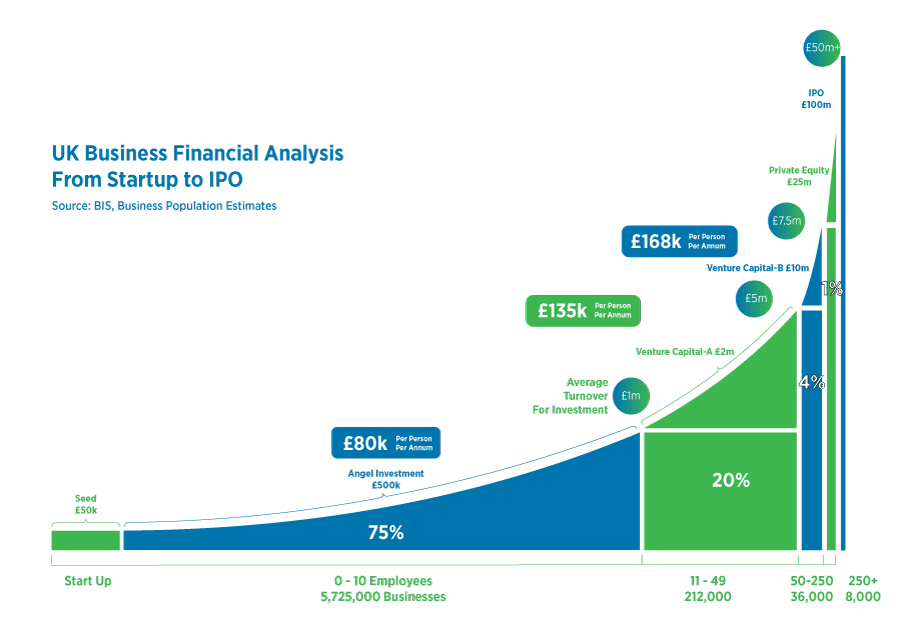
Pull out fifty CMO CVs, fifty marketing strategies, and fifty agency proposals, and they will look virtually identical. They have for decades. The reason is the same in every case: an inability to move away from the 1:1 mentality that treats every prospect as a separate manual task and keeps new business permanently constrained.
The average CMO tenure in the UK and USA is still the shortest of any C-suite role — around four years at large companies, and considerably less at technology businesses where the pressure to show results is highest. They come in, promise the earth, spend three months settling in, twelve months executing the plan, and then spend three months quietly looking for the next job when it becomes clear the results are not materialising. We see this pattern repeat without end.
The most striking example I came across on LinkedIn was a CMO at a 700-person software business who had held eighteen different jobs. She had never stayed long enough in any one role to find out whether her plan had actually worked.
So I go back to the same question: do the figures stack up?
3. Businesses Forced to Play Nice
Business owners listened to their staff and to big tech. They accepted the ROI arguments. Marketing automation was sold as a lead machine — it would bring inbound interest flooding in, it would monitor everything, it would make the whole process measurable and manageable. The clue is in the name though: it is marketing automation. Not lead automation. Not revenue automation.
As the marketing processes kept failing to deliver, the only available response was to hire someone new — someone who would arrive with fresh promises and a new plan. And to attract that person, the working environment had to look appealing. Ball pits. Table football. Free beer on tap. These became the visible symptoms of a business trying to compensate for a model that was not working by making the office a more attractive place to sit while it failed.
None of it addressed the underlying problem. The model was wrong. No amount of new hires or office perks changes that.
4. Why Marketing Automation Fails for B2B
The reason marketing automation does not work in B2B is straightforward. B2B businesses sell products and services that are supposed to increase another business's profitability. That is the entire premise of the transaction. And yet the ROI evidence used to sell automation platforms to CEOs was built almost entirely on B2C results — trainers, jeans, cars, insurance, energy drinks. Things a consumer can pick up, look at, and decide on the spot that it suits them. No B2B buyer has ever looked at a SaaS platform or a managed service and thought "this looks good on me."
Within the sales process, marketing automation simply replaced cold calling with a digital equivalent. Where cold calling used to mean getting a name and number and picking up the phone, automation means getting an email address in exchange for a PDF download. Same transaction. Same friction. Just slower and more expensive to run.
The vendor's automation tools attempt to force a prospect into a micro-transaction before they have even established what is being offered. Asking for an email address and phone number upfront makes people back away. We know from our research that 83% of B2B buyers complete their requirements before they speak to anyone in sales — they research digitally, anonymously, and on their own terms. Or they give their details, download the content, and immediately unsubscribe.
A Forrester study found that fewer than 1% of B2B prospects who went through the so-called purchasing funnel actually became revenue-generating customers. Less than one percent. That is the return on a process that most B2B marketing budgets are still almost entirely built around.
There is further damage that automation does, and it rarely gets talked about. PDF downloads and gated content are invisible to search engines. Google cannot index what is behind a form. Neither can any other search engine. So if your best content is locked away, it earns you nothing in terms of organic visibility — no ranking, no discovery, no proof that anyone is actually reading it.
Google's position in all of this matters. If a web page earns a high organic ranking, it is effectively a signal that the content is well-structured and genuinely relevant to the audience searching for it. That is worth something. But it only works if the content is actually accessible. Gated content gets none of that benefit.
And that is before you factor in the cost of Google Pay-Per-Click — the mechanism businesses use to bypass organic search entirely and buy their way onto page one, as long as they outbid every competitor targeting the same terms. The economics of that are brutal, particularly for B2B where the search volumes are lower and the cost per click is higher.
The full sequence looks like this. Your marketing team creates three banner ads to A/B/C split test the copy. Each ad links to a landing page. The landing page asks for an email address in exchange for content. Then you wait. And at every single stage, you have introduced friction:
- Friction on the pay-per-click advert — does it work or not?
- Friction on the landing page — was it A/B/C split tested or multivariate? Does the layout convert?
- Friction on engagement — you are demanding a transaction before the prospect has seen a single piece of your thinking
That is why the PPC — B2B — marketing automation sequence is broken. Not occasionally. Structurally.
5. A Biased Recruitment Cycle
So the cycle continues. A new marketing hire gets three months to settle in. A year to implement the plan — the one they promised would deliver results in the interview. Then, when it becomes clear nothing has materially changed, three more months to find a new position before the inevitable conversation happens. Eighteen months, start to finish, and then repeat.
The only variation on this pattern is when the CEO gets so involved in day-to-day marketing decisions that the CMO becomes harder to remove — not because the plan is working, but because the CEO is now personally invested in it. The CMO keeps their job. The plan still does not work.
You will not see the kind of thinking I am describing here on any standard marketing CV, and there are three reasons for that:
- Recruitment agencies are not business consultants. They match a brief, they do not challenge it.
- They filter candidates against what you asked for, which is almost always a slightly better version of the person who just left.
- The eighteen-month churn is genuinely good for their business. There is no incentive to break the cycle.
The environment this creates is one where salespeople have been conditioned into waiting for leads. Cold calling is handed to BDRs and SDRs. Marketers and salespeople who have never run a business have no basis for offering entrepreneurial thinking or challenging the way new business is pursued — that is seen as the CEO's domain. So they keep their heads down, execute what they are given, and none of it is their neck on the line if it does not work.
Sales and marketing both have a strong incentive for things to stay exactly as they are. They get paid regardless of whether the model works. If the board comes up with something new, they will execute it. But they are not going to challenge the status quo.
6. Consistent Business Failure
In the UK, around 317,000 businesses started in 2024 and 280,000 closed. That is not a new phenomenon — it has been running at roughly those proportions for years. The statistics below are not comfortable reading:
- 20% of businesses fail in year one
- 30% of businesses fail by year two
- 50% of businesses fail by year three
- 91% of businesses fail by year ten
- 40% of invested businesses fail entirely
- 80% of invested businesses fail to achieve their own targets
- 95% of invested businesses fail to deliver an ROI for investors
- Over 50% of business failure reasons are marketing-related — CB Insights
- 83% of B2B buyers define their requirements before speaking to a salesperson — 6Sense 2025
- Fewer than 1% of prospects who go through the so-called funnel become revenue-generating customers — Forrester
- Around 1 in 400 cold calls results in a genuinely interested party — University of Life
- Average CMO tenure remains the shortest of any C-suite role — Spencer Stuart 2024
No one in the mainstream business conversation seems to know what to do about any of this. We do, and I will come to that shortly.
Before I do, I want to address digital transformation, because it comes up constantly. Digital transformation as it is typically understood is almost entirely focused on internal business processes — logistics, workflow, operations. Platforms like ServiceNow, Pega, Appian, and Bizagi are genuinely useful for making those processes more efficient. But they are not selling platforms. Customer experience is part of the conversation, but it only matters if the route to becoming a customer in the first place was built on something other than pressure tactics, manufactured urgency, and ABM strategies that require half the business to get involved before a prospect has even raised their hand.
If the relationship starts with distrust — which is what most standard B2B sales tactics produce — then no amount of clever customer experience design will create loyalty. Buyers switch when it suits them. Because nothing in the initial engagement gave them a reason to stay.
7. Sales & Marketing Transformation

Bill McDermott, CEO of ServiceNow, put it plainly in an interview a few years ago. Digital transformation, in his view, means taking an existing problem and addressing it through an entirely different lens. He made the point that 75% of the Fortune 500 companies on the list today will not be on it in a few years' time, and that better is no longer good enough — exponential thinking is what the 21st century requires. IT architecture, he argued, is now the business architecture.
ERP Magazine — ServiceNow — Bill McDermott
He is right. And yet when you look at where digital transformation is actually happening inside most B2B businesses, it is almost entirely in operations and process. Sales and marketing are left completely untouched. Everyone wants to be the hero who gets the widget from A to B more efficiently. When it comes to how the business actually finds and engages new customers, there is nothing. Crickets.
We have come full circle back to the mar-tech stacks, the ball pits, and the free beer — with the same blind spot in place. Cameras, microphones, and lights are digital products too. They are necessary components of a modern content and marketing operation. But most marketers have no experience with them, find them intimidating, and dismiss them as unnecessary expense or someone else's responsibility. That attitude is costing businesses far more than the equipment would.
8. Your Total Addressable Market
There is only one way to break free from the permanent low performance that a 1:1 model produces. You have to adopt a one-to-many approach — and then build the strategy and infrastructure around it.
It starts with understanding how to reach your total addressable market on a consistent, repeatable basis. That means stopping the money going into cold calling and demand generation platforms that produce almost nothing, and redirecting it into a model that actually connects with the market at scale.
The starting point is accepting the numbers. At any given time, around 95% of your market is not actively looking to buy. Roughly 1% of your total addressable market is in buying mode each week. The job is to be consistently visible to all of them, so that when the 1% do become active, your business is already in their thinking — not a cold name on a list that a BDR is about to dial for the first time.
Every potential prospect needs to be able to get everything they need from you online, at any time, without having to speak to anyone. And when they do want to speak to someone, a trained sales professional should be available — by phone, video, chat, or whichever channel the prospect prefers.
To put the scale of this in context, the UK private sector currently has around 5.7 million businesses. The breakdown by size is as follows:
- Up to 49 employees — 5.64 million
- 50 to 249 employees — 38,435
- 250 or more employees — 8,335
Now work out what 1% of your target vertical looks like. If your addressable market is 20,000 businesses, that is 200 potential buyers in active research mode every single week. A telesales team of BDRs making calls at roughly 75 per day — needing around 400 calls to find one interested party — will never cover that ground. The maths simply does not work.
9. Digital Selling is Not eCommerce
The alternative is to educate your prospective customers with genuinely useful content and let them come to their own conclusions at their own pace. That is the essence of a digital selling strategy. It is the ability to engage with prospects so they can self-serve — from the moment they have an idea and start researching, all the way through to placing an order — without needing a human being to push them through each stage.
I am not talking about AI tools, which at the moment are more useful for producing content quickly than for replacing the commercial thinking that needs to sit behind any strategy. AI amplifies the model you give it — if the model is wrong, AI just gets you to the wrong outcome faster. Fix the model first. Then use AI to execute it.
This is not a new concept in principle. B2C businesses have run on it for years. But you are not selling trainers or energy drinks. You are selling high-value, complex products or services where the buyer needs to trust you before they will consider a conversation, let alone a purchase. The content you publish — articles, videos, podcasts, case studies, how-to guides — is how that trust gets built before anyone picks up the phone.
When this is done properly, the financial implications are significant. Fewer telesales people are needed to find prospects. Fewer closers are needed because more revenue comes from self-service. Commission spend drops. And as your content becomes visible to search engines — because it is no longer locked behind forms — your organic visibility builds month on month, which means your cost per acquisition falls while reach increases.
The gearing ratio shifts from 1:1 to 1:many. There is no ceiling on how many businesses can find, read, watch, and act on your content. One properly trained person, running a consistent digital publishing and distribution operation, can reach your entire addressable market every week. That makes a whole telesales team structurally redundant.
10. How Do We Know This?
I started technology businesses. I personally sold millions of pounds of telecoms technology and integrated CRM. I know what it looks like from every angle — running the business, doing telesales, field sales, installation, implementation, and training. I have experienced all of it.
What that experience tells me, stripped back to the essentials, is this:
- The business must be clear on who and where its market actually is
- It must be able to tell that market it exists — easily, cost-effectively, and repeatedly
- Prospects must be able to self-serve all the way to placing an order
- Every contact channel must be available — phone, video, chat, email, and live
These four things sound obvious. But the moment a business adopts telesales as its primary route to market, it installs a 1:1 ratio and makes all four impossible to achieve at scale. You are back to square one by design.
The question I would put to you as CFO is this: does this approach to change make financial sense for your business? And does it make sense for new business generation? You are in a position — perhaps the only position in the business — to take this seriously, look at it dispassionately, and decide whether it is worth sharing with your colleagues.
11. How to Get Started
Transitioning to digital selling begins with a change in perspective on the entire engagement process. It is not about prospecting, cold calling, or closing techniques. It is about aligning the business with how buyers actually behave — which is the same way you and I behave when we are researching something we want to buy.
When it comes to implementation, your business can start immediately. The first useful step is to look at what your existing teams have been producing over the past few years and assess how closely it aligns to the model I am describing here. That assessment alone often surfaces a significant amount of content that can be repurposed, repackaged, and made accessible without any gating or friction.
Our own website is built on digital selling principles. Everything on it is freely available. No access codes, no email forms, no login walls. That is the standard I would encourage you to hold your own operation to — and it is also why you can cross-check everything I am saying here without having to speak to us first.
12. The Transition from Old to New
The most common first question is: how long will it take? The honest answer is that it depends on what content already exists and how much of it can be updated and made accessible rather than rebuilt from scratch.
My recommendation is to build the digital selling strategy in parallel with whatever you are currently running. As the new approach gains traction — more content visible, more traffic coming in organically, more prospects self-serving — the dependency on the old model naturally decreases. You do not need to pull the plug on day one.
A realistic timeline to get the foundations in place and operational is four to six months. That is why a conversation with a specialist early in the process is worth the time — not to be sold something, but to scope what already exists and identify the shortest route to a working model.
 Nigel Maine is the founder of salesXchange and the architect of the sX Operating System — a B2B commercial framework built from three decades of running technology sales, not from marketing theory.
His work is grounded in a single conviction: that most B2B growth models were designed for consumer buying behaviour and have never been corrected. salesXchange exists to fix that. Nigel works directly with CEOs and commercial leadership teams across Technology, SaaS and Professional Services to rebuild their GTM infrastructure from first principles.
He is a published author, public speaker and hosts a weekly B2B live show broadcast across LinkedIn, YouTube and Facebook. Contact: 0800 970 9751 or


