


Most B2B Companies Are Invisible Online — and Their SEO Strategy Is Why
Spend any time looking at how B2B companies approach search and you will see the same problem repeated everywhere. They chase individual keywords, publish isolated blog posts, and wonder why their rankings go nowhere. The answer is not more content. The answer is a structured B2B SEO strategy built around topical authority — and most businesses have never been shown how to do it properly.
Topical authority is not a trend. It is the way search has been moving for the better part of a decade, and in 2025 it is no longer optional. The 2024 Google Content Warehouse API leak confirmed what many SEOs had long suspected: Google uses siteFocus and siteRadius metrics to assess how concentrated a site is around its core topics. SiteFocus measures depth and authority within a subject area, while siteRadius evaluates how far content strays from that focus. In plain terms: publish outside your lane and Google penalises you for it. Publish comprehensively within your lane and Google rewards you. That is the whole game.
The reason this matters so much for B2B is what your buyers are doing before they ever speak to you. Buyers still mostly or fully define their purchase requirements 83% of the time before speaking with sales. B2B buyers are nearly 70% through their purchasing process before engaging with sellers — and 81% of buyers already have a preferred vendor at the time of first contact. If your content is not showing up during that silent research phase, you are not on the shortlist. You are not even in the conversation.
We track this closely at salesXchange. The 95% of your market that is not actively buying right now is still researching, still forming opinions, still deciding who they trust. When someone eventually does move into buying mode, they go back to the names they already know. That is why organic visibility is not a vanity metric. It is a pipeline metric.
How to use topical authority in B2B SEO comes down to a structural decision. Rather than treating every page as a standalone document optimised for a single keyword, you build clusters of interlinked content around the subjects your buyers actually care about. A pillar page covers the broad topic. Supporting cluster pages go deep on the subtopics. The internal links between them signal to search engines that your site has genuine command of the subject. Keywords still matter, but they are now part of a broader equation that centres on topical authority — a signal of how well your site covers a subject. Search engines prioritise depth, consistency, and content relationships over isolated keywords.
This is fundamentally different from how most B2B companies have been doing SEO. Traditional keyword-focused SEO produces a collection of disconnected pages that each fight for attention on their own. A topical authority structure makes those pages work together. The cluster lifts the pillar. The pillar lifts the cluster. A 2024 study by Graphite found that pages with high topical authority gain traffic 57% faster than those with low authority. That compounds over time in a way that individual keyword chasing never does.
The B2B context makes this even more pointed. The structural differences between B2B and B2C search engine optimisation need to be clear. B2B buying decisions involve multiple stakeholders, longer evaluation cycles, and far more research depth than a consumer purchase. Typical B2B purchases involve teams of around 10 people, and 72% of B2B purchases involve high-complexity buying groups spanning multiple functions such as IT, operations, finance, and end users. Each of those people is searching. Each of them needs a different angle on the same topic. A properly structured topical authority cluster covers all of those angles from one coherent content architecture.
There is also the question of AI search. In 2025, topical authority is the difference between being cited in AI Overviews versus being buried beneath them. B2B buyers doing serious research still click, still read, and still need depth that a three-paragraph AI summary cannot provide. Build the depth and you get cited. Publish thin, scattered content and the AI summary replaces you entirely.
As a B2B SEO consultant looking at topical authority, I have watched businesses spend years producing content that does nothing because it was never connected into a coherent structure. This article covers everything: what topical authority clusters are and how they differ from keyword-led SEO, how to build and organise them for a B2B site, how B2B SEO strategy differs from B2C, how to measure what is working, and what real-world implementation actually looks like. You can also read our SEO Guide for B2B for the wider strategic context, and our piece on E-E-A-T and B2B success which sits directly alongside this subject.
This is a long-term strategy. It requires consistent content production, proper internal linking, and ongoing monitoring of rankings, traffic, and conversions. But it is the approach that compounds — and in a market where 95% of your prospects are not ready to buy today, compounding organic visibility is one of the few assets that actually works in your favour.
What This Article Covers
Before you read a single word of advice in this article, here is what the evidence tells you about where B2B buyers are right now. Organic search drives 76% of all trackable B2B website traffic and generates 44.6% of total B2B revenue. SEO leads close at 14.6% — compared to 1.7% for outbound. And yet most B2B businesses are still spending money on tactics that do not reach 95% of their market, because 95% are not actively buying at any given moment.
The businesses winning in search are not throwing out random content and hoping Google notices. They are building structured, interlinked content around core topics — what we call topical authority clusters. Content organised this way drives approximately 30% more organic traffic and holds rankings two and a half times longer than standalone pages. That is not a small difference. That is the gap between a content strategy that compounds over time and one that flatlines after a few months.
This article covers everything you need to know to build that structure for your B2B website. Here is exactly what we go through:
- Introduction
- Why SEO matters more than ever for B2B organisations
- Why topical authority clusters are the structure that makes it work
- What this article covers and how to use it
- Understanding Topical Authority Clusters
- What they are and how they work
- How they differ from traditional keyword-focused SEO
- Why B2B businesses specifically benefit from them
- Setting Up Topical Authority Clusters
- Identifying your core topics and subtopics
- Keyword research and search intent analysis
- Organising content into clusters
- Creating pillar content and cluster pages
- Internal linking and site navigation
- Topical Authority Cluster Diagram & Key
- Benefits of Topical Authority Clusters for B2B Organisations
- Greater visibility in search results — and in AI-generated answers
- Better user experience and stronger engagement
- Establishing genuine expertise in your sector
- Building trust and credibility with the people who actually buy
- Generating qualified leads and improving conversion rates
- Implementing Topical Authority Clusters in Your B2B SEO Strategy
- Running a content audit and gap analysis
- Building a content creation plan
- Optimising content for topics and search intent
- Building external links that reinforce your authority
- Measuring performance and making improvements
- Key Differences Between B2B and B2C SEO Strategies
- Complex buying cycles and multiple decision-makers
- Targeting industry-specific topics and search terms
- Educational content that builds credibility over time
- Account-based marketing and how SEO supports it
- The role of influencer and peer credibility in B2B search
- Case Studies: Topical Authority Clusters Working in B2B
- Example 1: How a structured SEO rebuild changed one company's search performance
- Example 2: Organic traffic and conversion improvements from cluster implementation
- What the real-world cases teach us
- Key Takeaways
- FAQs
- Conclusion
- What topical authority clusters actually do for your business
- Why now is the right time to act
- Why continuous monitoring is not optional
- Where SEO is heading — and why this structure is built for it
1. Introduction
A. Why SEO Matters for B2B Organisations
I want to start with something that should be obvious but clearly isn't, because most B2B businesses are still ignoring it. Your buyers are not waiting for your sales team to call them. They are already online, researching their options, forming opinions, and building shortlists — long before anyone in your business knows they exist.
The numbers make this impossible to argue with. 6sense's 2025 research across nearly 4,000 B2B buyers found that 95% of the time, the winning vendor is already on the buyer's Day One shortlist before any sales contact takes place. Decisions are locked in before your team picks up the phone. And according to Gartner's 2025 survey, 73% of B2B buyers actively avoid suppliers who send irrelevant outreach. That is not a pipeline problem. That is a visibility problem.
Our own research at salesXchange puts 83% of B2B buyers researching digitally before they speak to anyone. Two-thirds of U.S. B2B buyers use search engines as their primary discovery channel. If your website does not show up when those buyers are looking, you simply do not exist as far as they are concerned. Cold calling will not rescue you from that. We know — it takes around 400 calls to find a single interested party, at roughly 75 calls a day. You do the maths.
This is why SEO is not a nice-to-have for B2B. It is the mechanism by which you become visible to the 95% of your market that is not actively buying right now, so that when they do move, you are already on their list. Search engine optimisation is how you earn that position before the conversation starts.
B. Why Keyword-Based SEO Alone No Longer Works
Here is where most businesses waste their effort. They hire an agency or an in-house person, they chase a list of keywords, they get a few pages optimised and published, and then they wonder why nothing moves. The problem is they are playing a game Google changed years ago.
Google's own patents explicitly reference "topical clusters" when weighting links. Ranking for a single keyword is not how the algorithm works anymore. Rather than measuring general domain authority, Google now evaluates how comprehensively you cover specific topic areas. Sites that build clear topical relationships and answer related questions consistently outperform those with broad but shallow coverage. That is a structural shift, not a tweak.
Google's Helpful Content and Knowledge Graph systems actively favour websites that demonstrate comprehensive expertise in their domain. Google's Gary Illyes confirmed in 2024 that links are no longer in their top three ranking factors. What has replaced them? Depth of coverage. Demonstrated expertise. Content that is logically structured around a subject, not scattered across disconnected pages chasing disconnected keywords.
We also have to face the AI dimension honestly. 94% of B2B buyers now use large language models during their buying process, and AI Overviews appear on up to 30% of search queries. If Google's AI systems are pulling answers from sites that have established topical authority, and your site has not, you are invisible there too. The search landscape has changed. A page-by-page keyword approach will not cut through.
The answer is topical authority clusters. Not because it is fashionable, but because it is how Google now decides who to trust and how buyers now decide who to consider. The two things happen to point in the same direction.
C. What This Article Covers
This article gives you a complete picture of topical authority clusters for B2B — what they are, why they work, and how to build them. I have written it for business owners and marketing leaders who want to understand the strategy, not just follow instructions without knowing the reasoning behind them.
We will cover the definition and mechanics of topical authority clusters, and how they differ from the keyword-focused approach most businesses are still using. We will look at the specific benefits for B2B organisations, including improved search visibility, better quality traffic, and what it takes to become a trusted source in your market. We will then walk through the practical process: how to identify your core topics and subtopics, how to structure your content into clusters, how to build pillar pages with supporting cluster content, and how to interlink it all so that both search engines and your readers can follow the logic.
We will also look at why B2B SEO is different from B2C, cover what performance monitoring actually looks like in practice, and include real examples of organisations that have done this well. By the end, you will have enough to make a decision about your own approach and enough to start building it properly.
One final point before we get into it. AI tools — ChatGPT, Claude, Gemini and the rest — can help you produce content faster. But they amplify whatever model you give them. If your content strategy is built on scattered keywords and shallow pages, AI will just help you produce more of the same, faster. Get the structure right first. Then use the tools.
2. Understanding Topical Authority Clusters
A. What They Are and Why They Work
A topical authority cluster is a structured group of interlinked content pieces built around a single subject area. There is one central pillar page — a comprehensive piece that covers the broad topic — and a series of supporting cluster pages that each go deeper on a specific subtopic. Every cluster page links back to the pillar, and where it makes sense, they link to each other. The result is a content architecture that gives search engines a clear map of your expertise.
This is not a new idea, but it has become the dominant approach because of how search engines now work. According to Moz's 2024 Search Ranking Factors report, keywords and backlinks now account for less than 40% of ranking influence. The rest comes from semantic signals — and topical authority clusters are precisely how you generate them. Topical authority measures a site's breadth, depth, and consistency in covering a specific subject area, and Google's Helpful Content and Knowledge Graph systems favour websites that demonstrate comprehensive expertise in their domain.
The logic is straightforward. Topical authority means a website is recognised by search engines as a trusted expert on a specific subject. Instead of ranking a single page for a keyword, Google evaluates whether your entire site consistently covers one topic in depth and with clear structure. That matters enormously when you are a B2B business competing for attention in a crowded market, where 83% of buyers have already done their digital research before anyone on your team even knows they exist.
B. How It Differs from Traditional Keyword SEO
Old-school SEO was built around individual keywords. You picked a search term, optimised a page for it, and hoped it ranked. Each page was essentially an island. There was no connective tissue, no signal to Google that you understood the subject at any depth. The approach worked when search engines were crude. They are not crude any more.
One of the core SEO best practices now is shifting from targeting single keywords to covering entire topics in depth. Google and AI-driven search engines now reward structured content that demonstrates topical authority — not just relevance. That shift has been confirmed repeatedly through Google's own updates and patents. Google's patents explicitly use the notion of topical clusters when weighting links. A Google patent on ranking documents notes that "when a topical cluster associated with the source document is related to a topical cluster associated with the target document, the link has a higher probability of being selected." In plain terms: links between pages on the same topic carry more weight than links between unrelated pages.
Traditional keyword SEO also creates a structural problem. Individual optimised pages compete against each other for the same queries, dilute your authority, and confuse search engines about what your site actually stands for. Google expects a clear, focused topic per page and by extension per site section, suggesting a site should group similar topics rather than mix them. Topical clusters solve that problem by design.
There is another dimension to this that matters right now. This shift has become even more critical with the rise of AI search engines like ChatGPT, Claude, Gemini, and DeepSeek. These tools pull answers from sources they consider authoritative and well-structured. LLMs like ChatGPT, Claude, and Gemini cite structured, comprehensive sources, and thin or disconnected content is ignored in AI-generated results. If your content is scattered and shallow, you will not appear in those answers. If it is deep, structured, and interlinked, you will. Your cluster architecture directly determines your AI search visibility.
C. Why B2B Businesses Need This More Than Anyone
Consider the buying reality B2B businesses are operating in. Even with earlier buyer contact, buyers still mostly or fully define their purchase requirements 83% of the time before speaking with sales (6Sense, 2025). That means your content is doing your selling long before your sales team gets involved. If that content is a loose collection of blog posts with no structural logic and no depth, you are invisible at the most critical stage of the buying process.
We know 95% of the market is not actively buying at any given moment. The buyers who will matter to you in six or twelve months are researching now. In 2024, 86% of enterprise buyers short-listed at least one product they had already heard of before beginning formal research, making brand awareness a pre-condition for even being considered. You get onto that shortlist by being the business that consistently shows up with credible, well-organised content on the topics your buyers care about. A topical cluster structure is how you achieve that systematically.
The benefits for B2B are concrete and measurable:
-
Stronger organic search rankings across an entire topic. The three most important components are content depth, internal linking, and consistency. When all three are aligned, search engines treat your site as a reliable source, improving rankings across entire topic clusters instead of single pages. You are not chasing one keyword. You are building authority that lifts every page in the cluster.
-
Visibility in AI-generated answers. The websites being cited in AI-generated answers are those that demonstrate topical mastery. If you want your brand visible not only on Google but also in AI-powered responses, building topical authority is no longer optional. This matters because your buyers are increasingly using ChatGPT, Gemini, and similar tools as their first research step.
-
A better experience for your readers. When your content is structured around a cluster, buyers can navigate from a broad overview into the specific detail they need. They stay longer, engage more, and build familiarity with your thinking before they ever speak to anyone. Sites with strong overall quality, good E-E-A-T, clear topical authority, and solid user experience tend to benefit most from Google's updates. That benefit compounds over time.
-
Qualified traffic, not random traffic. A well-built cluster addresses every angle of a subject — the broad question a new prospect asks and the specific technical question a buyer asks just before they commit. When multiple interlinked pages cover a subject from different angles — guides, use cases, comparisons — Google better understands the site's topical focus and ranks pages higher within that domain. You attract the right people at the right stage of their process.
-
A credible presence that builds over time. Consistently publishing within a structured cluster tells search engines you are serious about the subject. Consistent publishing reinforces topical authority by signalling long-term commitment to a subject, and search engines trust sites that continue to update and expand their topic coverage over time. The businesses that build this infrastructure now will be significantly harder to dislodge in two or three years.
-
A practical framework for your content calendar. One of the reasons most B2B content efforts stall is that there is no system. People publish when they think of something, not when the architecture requires it. A topical cluster gives you a map. You know which subtopics you have covered and which gaps remain. When new content fills gaps in your topical map, it strengthens existing pages instead of competing with them. That is a completely different dynamic from the random blog publishing most businesses default to.
The following sections cover how to build the cluster structure, what goes into pillar content versus cluster content, and how to measure whether it is working.
3. Setting Up Topical Authority Clusters
A. Identifying Core Topics and Subtopics
Start by working out what your business actually knows and what your prospects genuinely need to understand before they buy. Those two things should overlap almost completely. Your core topics are the main areas where you want to be found, and the subtopics are the specific questions, problems and decisions that sit underneath each one.
Do not start by guessing. Look at the conversations your sales team has. Look at the objections that stall deals. Look at the searches that bring people to your site already. Industry research, trade publications and competitor content all tell you what the market is thinking about. Cross-reference that with your own expertise and you will quickly see which subjects you can write about with real authority — and which ones you would just be filling space on.
We track this carefully at salesXchange. The data is consistent: 83% of B2B buyers define their requirements digitally before they speak to anyone in sales. That means the decision about whether you are credible enough to be worth contacting is made on your website, long before any conversation happens. Your topic selection is not a content marketing exercise. It is your sales strategy made visible.
B. Conducting Keyword Research and Analysis
Once you have identified your core topics, you need to understand how your prospects search for them. Keyword research maps their language onto yours. The gap between how you describe what you do and how a buyer types a query into Google is often wider than businesses expect.
The main tools for this are Google Keyword Planner, SEMrush and Ahrefs. All three are still current and actively developed. Google Keyword Planner is free and pulls data directly from Google's ad platform — useful for volume direction, less useful for organic SEO depth. Ahrefs and SEMrush go much further: competitive analysis, keyword difficulty scoring, content gap analysis and backlink data. If you are serious about building topical authority, one of the paid tools is worth the investment. They are not interchangeable — Ahrefs is stronger on backlink analysis, SEMrush is broader across marketing channels.
What you are looking for from keyword research is search intent. Not just which terms get searched, but why someone is searching them. A person searching "what is account-based marketing" is in a very different place from someone searching "ABM agency pricing UK." Both searches might sit inside your topical cluster. They need different content. Understanding that distinction is the whole point of the exercise.
C. Organising Content into Clusters
Now you have topics and keywords, you need a structure. This is where most businesses go wrong. They create content as individual pieces with no logical relationship to each other. Google sees a pile of disconnected pages. Visitors hit a dead end and leave. Neither outcome is what you want.
A cluster groups content so that every piece has a home. Related subtopics sit together. They connect to each other and they connect to a central pillar piece. The structure is hierarchical — category page at the top, pillar articles beneath it, cluster articles supporting each pillar. Everything has a clear relationship to everything else.
Think of it less as a filing system and more as a demonstration of depth. When Google crawls your site and finds twenty pages that all address different facets of the same subject, all linking to each other coherently, it understands that you know this subject properly. That is how topical authority is established. Not by one very long article, but by systematic coverage across a well-organised structure.
D. Creating Pillar Content and Cluster Pages
Pillar content is the anchor. It covers a core topic comprehensively — not exhaustively on every subtopic, but broadly enough to give a reader the full picture and direct them to more detailed content where they need it. The pillar piece links out to the cluster pages. Those cluster pages link back. That is the architecture.
Each cluster page goes deep on one specific subtopic. If the pillar is "B2B demand generation," a cluster page might cover "how to build a lead nurturing sequence" or "the role of content in shortening sales cycles." Specific, focused, useful. Not padding. Not keyword stuffing. Actual answers to actual questions your prospects are asking.
The quality bar matters. Google's ranking systems have become significantly better at distinguishing genuinely helpful content from content that merely contains the right words. Write for the person reading it. If your cluster page genuinely answers the question it promises to answer, it will serve both your prospect and your search rankings.
E. Interlinking and Internal Navigation
Internal linking is the mechanism that makes the cluster work. Without it, you just have a collection of pages. With it, you have a network that signals structure, relevance and depth to search engines — and keeps human readers moving through your content.
Every cluster page should link back to its pillar. The pillar should link to each cluster page. Where it is genuinely relevant, cluster pages should also link to each other. Use descriptive anchor text that tells both the reader and the search engine what the linked page is actually about. "Click here" is useless. "How to structure a B2B content audit" is informative.
Navigation matters too. Menus, breadcrumbs and related-content suggestions help readers find adjacent material without having to go back to a search engine. The longer someone spends reading your content, moving between pages that are all genuinely relevant to what they came to find, the stronger the signal to Google that your site deserves to rank. Keep the internal paths obvious and logical.
Do this consistently across your whole site and the effect compounds. Each new piece of content you add strengthens the cluster it belongs to, which strengthens the category, which strengthens the overall domain authority. That is the long-term return on the structural investment.
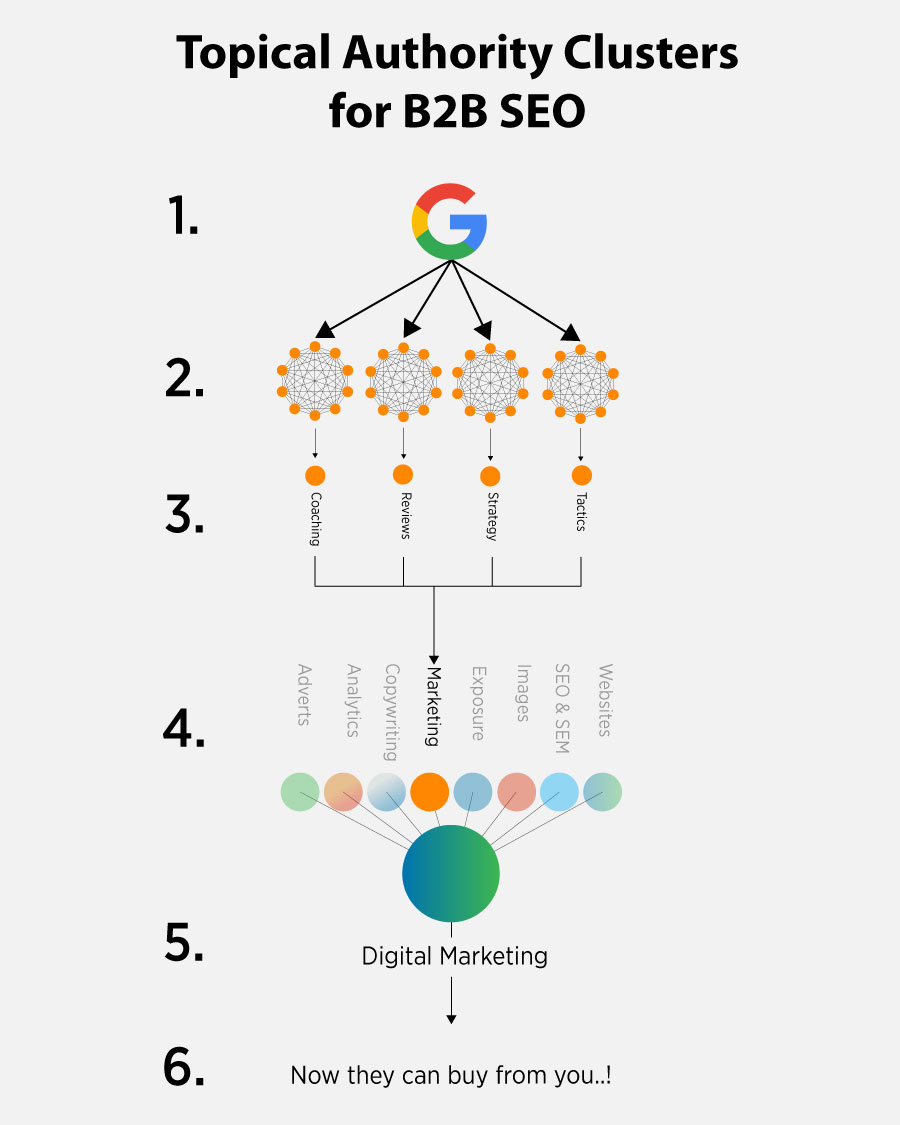
Topical Authority Clusters Diagram – Key
This diagram shows the path of a Googlebot crawler.
- Google's objective is to serve their users with the best possible search results.
- Search is a mathematical calculation — an algorithm. Think of it as X+Y=Z. Your content must conform to that calculation to allow Google to crawl the page and index it correctly.
- Google crawls from the page level inward. It does not arrive at your root domain — say, salesxchange.co.uk — and then follow your navigation menus. It arrives on individual pages and works from there.
- When Googlebot lands on a page, it checks a series of factors before deciding how to treat it:
- What is the page about? What page title, meta description and browser title have been used, and are they the right length?
- How is the content written? Is it clear and readable, or dense and technical?
- How is the page structured? Are H1, H2 and H3 headings used correctly? Are there bullet lists, numbered lists, images and links?
- Page speed matters. A slow-loading page or oversized images that delay the crawler count against you.
- Then comes the first dimension of authority: which pages does this article link to, and which articles link back to it?
- All your associated articles interlink, creating a mesh of content where each piece supports the others.
- Each interconnected article connects to a pillar article within its group. In our example, we have four pillar articles:
- Coaching
- Reviews
- Strategy
- Tactics
- Each of the four pillar articles connects to a main category page — in this case, Marketing — which is one of eight categories sitting under the section Digital Marketing.
- The main section denotes a top-level area of the business.
- Following this structure achieves two things:
- Google can navigate your site without difficulty. It can see that every page connects to every other page through internal linking — both explicitly, through the link lists you have seen above, and contextually, through the keyword relationships we described in the research section covering Google Keyword Planner, SEMrush and Ahrefs.
- Your prospects are presented with a comprehensive, easy-to-navigate body of content that keeps them on your site longer, because every related piece they might want is already there and easy to find.
One practical note: this structure does not work well alongside marketing automation tactics and email registration forms that hide or restrict access to the educational content your prospects need. Gate your content and you break the cluster. The point is open access, not friction.
4. The Real Benefits of Topical Authority Clusters for B2B Organisations
Let me be straight with you. The reason I keep pushing topical authority clusters is not because it is a clever SEO trick. It is because it solves a genuine commercial problem. We know that 83% of B2B buyers research digitally before they speak to anyone. We know that 95% of your market is not actively buying at any point in time. That means the only way to be in the room when someone finally starts looking is to already be there — already trusted, already recognised, already covering the territory they are searching. Topical authority clusters are how you do that.
A. Better Visibility in Search Results
When you organise your content around core topics and their subtopics — with proper interlinking and logical structure — search engines can actually understand what your site is about. They do not just see individual pages. They see a body of work. And they treat it accordingly.
Google has been moving in this direction for years. The leaked Content Warehouse API documentation confirmed what good SEO practitioners already suspected: Google measures topical focus as a specific signal. Sites that concentrate on a defined subject area score higher on that signal than those spreading themselves thin across unrelated topics. A focused site covering one subject with depth can outrank larger, better-funded competitors who produce a scattergun of disconnected content.
The practical result is that your entire cluster begins to lift. When the pillar content ranks, it pulls the cluster pages up with it. When a cluster page starts ranking, it feeds authority back to the pillar. You are not fighting for one keyword. You are capturing a broad range of search queries that your buyers actually use at different stages of their research. That is how you get in front of the 95% who are not yet buying but will be.
B. A Better Experience for the People Visiting Your Site
There is a simple commercial logic here. Someone lands on one of your articles. They find it genuinely useful. They see clear links to related content that answers the next question in their head. They stay. They read more. They start to trust you before they have ever spoken to anyone at your company.
That is not a nice-to-have. Given that B2B buyers now prefer to carry out independent research through digital channels before engaging a supplier, your website is doing sales work whether you intend it to or not. The question is whether it does that work well or badly. A cluster structure, properly built, keeps visitors moving through your content rather than bouncing back to Google to find a better source.
When a visitor finds a page that answers their question and sees several related articles one click away, they are more likely to stay and explore. That reduces bounce rates, increases dwell time, and sends quality signals back to Google. The structure does multiple jobs at once.
C. Demonstrating Expertise Without Claiming It
Here is something I have noticed over thirty years. Companies that spend the most time telling people how expert they are tend to be the least convincing. The ones who actually prove it — consistently, across dozens of articles, videos, and guides — do not need to say it. The evidence does the talking.
Topical authority clusters are how you prove it. When a prospective buyer works through your content and finds that you have covered their sector in real depth — the problems they face, the options available, the tradeoffs involved — they reach their own conclusion. They decide you know what you are doing. You have not sold them anything. You have informed them. That is far more powerful than any claim you could make in a brochure.
This matters especially in B2B. Research shows that 90% of buyers are more likely to engage with content from a brand they already recognise and trust. If your content infrastructure has been consistently building that recognition over months and years, your name is already on their shortlist before you know they exist.
D. Building Trust That Converts
Trust in B2B is earned slowly and lost quickly. Buyers research thoroughly. A 6sense study found that B2B buyers select a favoured vendor before engaging with sellers, and that pre-contact favourite wins the deal roughly 80% of the time. Read that again. Four out of five deals are won before first contact. The vendor who wins is the one the buyer already trusts from their research.
That is the commercial argument for building topical authority. It is not about rankings for their own sake. It is about being the business a buyer has already spent time with by the time they pick up the phone or fill in a form. Your cluster content has been doing the relationship-building before your sales team even knows there is a prospect.
Consistent, in-depth content also signals stability. A business that has published substantive material across a topic area over time looks like a business that is going to be around. That matters to buyers making significant purchases. Inconsistent or thin content — or worse, no content at all — does the opposite.
E. Attracting the Right Leads Rather Than More Leads
Volume of leads is largely irrelevant. What matters is whether the people arriving on your site actually have a problem you solve. Topical clusters, done properly, attract buyers who are already researching your specific subject area. They are not stumbling across a generic article. They are working through a structured body of content that maps directly to their challenge.
This is where the 95% rule becomes a positive thing rather than a depressing statistic. Most of your market is not buying right now. But they may well be researching, reading, comparing, building a picture. If your content is there throughout that process — genuinely useful, covering the topic from multiple angles — you become the natural first call when they are ready to act.
We have also seen this shift in how buyers use AI tools in their research. A 6sense study found that 94% of B2B buyers now use large language models during their buying process. AI platforms like ChatGPT, Perplexity, and Google's AI Overviews pull from sites with deep, well-structured coverage of a topic. If your cluster architecture is solid, you are not just ranking in traditional search — you are being cited in AI-generated answers. That is a new channel for getting in front of buyers who have not yet spoken to anyone.
None of this happens overnight. Topical authority is a long-term play. But it compounds. Every piece you add strengthens the cluster. Every cluster you build strengthens the site. And unlike a cold call campaign or a paid advertising budget, it does not stop working the moment you stop paying for it.
The next sections cover how to optimise content within your clusters and how to measure whether they are actually working.
5. Implementing Topical Authority Clusters in Your B2B SEO Strategy
A. Start with a Content Audit and Gap Analysis
Before you write a single new word, find out what you already have and where the holes are. A content audit without a gap analysis is half a job. Together, they tell you what exists, how it performs, and what is missing.
Go through every page on your site. Work out which core topics you actually cover, assess whether that content still serves the reader, and identify which subtopics are absent. Most B2B sites we look at over-index on awareness-level content and have almost nothing at the consideration or decision stage. The audit makes that visible immediately.
Use Google Search Console to find pages with high impressions but low click-through rates. Those pages are showing up in search but not earning the click — usually a title, meta description, or intent mismatch rather than a quality problem. Fix those before you create anything new.
For the technical side of your audit, Screaming Frog SEO Spider remains the most reliable crawler in the industry. Version 24.0 now integrates with AI assistants including Claude, and the semantic similarity analysis introduced in version 22.0 lets you detect off-topic pages and content that overlaps in meaning rather than just exact keywords. Pair it with Ahrefs or Semrush for competitor keyword gap analysis — find what your rivals rank for that you do not, then ask yourself whether those gaps actually matter to your buyers.
The point of the audit is not to generate a list of tasks. It is to make a decision. Which topics do you need to own? Which content is genuinely useful and just needs updating? What can be cut entirely? Most B2B content strategies fail because they are built on hope rather than data. The audit removes the guesswork.
B. Build a Content Creation Plan That Matches Your Clusters
Once you know the gaps, you need a plan to fill them — and the plan has to connect back to your topic clusters, not just a keyword spreadsheet.
Identify which pillar topics need a central piece of content and which subtopics need supporting cluster articles. Prioritise by commercial intent first, search volume second. The subtopics closest to a buying decision are the ones most worth addressing early. If nobody can find content that answers their question at the consideration stage, they will find a competitor who can.
Build a realistic schedule. One of the most common mistakes I see is over-ambition at the planning stage and under-delivery in execution. A consistent flow of well-structured content beats a burst of twenty articles followed by six months of silence. Google looks at the depth and consistency of your content across a topic area, not just individual page quality. A site that covers a subject thoroughly and keeps covering it signals authority. A site that publishes in fits and starts does not.
Bear in mind that 83% of B2B buyers research digitally before they speak to anyone. Your content is often the first — and sometimes only — impression you make. If your cluster has gaps, buyers doing that research will not find you at every stage of their thinking. They will find someone else instead.
C. Optimise Content for Topics, Not Just Keywords
Keyword research still matters, but it is no longer the whole game. Google now evaluates content in context. Sites that demonstrate clear, in-depth knowledge across a topic are more likely to rank for both head terms and the long-tail variations that surround them. One good article targeting one keyword is not topical authority. A structured set of interlinked pieces covering every meaningful angle of a subject is.
When you create or update content, optimise titles, headings, meta descriptions, and URLs to reflect the target topic — but do not stop there. Think about what questions a buyer at that stage would genuinely have. What would they search for next? Does your content answer it, or does it leave them to look elsewhere?
Structure your internal links so that cluster content points to your pillar page and the pillar links back out to each cluster piece. This is what tells Google how your content is organised. Linking your pages together with clear anchor text helps search engines understand your architecture and prioritise the right pages. Without that structure, even good content can struggle to rank because the search engine cannot read the relationship between your pages.
AI tools — ChatGPT, Claude, Gemini and others — can speed up research, draft outlines, and help identify related questions worth covering in each cluster. Use them to find gaps in your coverage and to check whether your content addresses the actual search intent behind a query. What they cannot do is replace your direct knowledge of your customers and market. The insight has to come from you. The AI executes it.
D. Build External Links the Right Way
Backlinks still matter. Google confirmed in 2024 that it quietly revised its stance from backlinks being "a very important part" of SEO to simply "an important part" — a small change that signals where things are heading. Quality and topical relevance now count for far more than volume. A link from a niche-relevant, trusted source in your industry is worth more than a dozen links from unrelated high-authority domains.
Chasing links for their own sake is a waste of time and can actively hurt you. Manipulative link-building tactics are penalised. The approach that works is earning links by producing content worth referencing — original research, detailed guides, data your industry does not have elsewhere.
For B2B specifically, the most legitimate link-building routes are industry publications, partner organisations, research citations, and executive visibility. Guest content on relevant trade sites still works when it is genuinely useful rather than just a vehicle for a link. Digital PR — getting your expertise cited by journalists covering your sector — generates the kind of editorially earned links that carry real weight.
There is also a broader point here that goes beyond traditional SEO. AI-powered tools like ChatGPT, Perplexity, and Gemini are increasingly the first place buyers go to research a topic. These systems assess whether a source feels complete, authoritative, and credible. Your brand being mentioned and cited across respected sources in your space is becoming a signal for AI visibility, not just Google rankings. The two are converging. Build your authority properly and you serve both.
E. Monitor Performance and Keep Improving
Topical authority is not a project you complete. It is something you build and maintain. Search behaviour changes. Your market changes. New competitors produce content. Google's algorithms keep evolving — Google's 2024 and 2025 core updates continued to raise the bar for content quality and original insight, with explicit targeting of thin or unhelpful content.
Track organic search rankings, traffic, and engagement metrics for each cluster. Watch which cluster pages are pulling in qualified traffic and which are underperforming. Look at time on page, scroll depth, and whether visitors move from cluster content to your pillar and then towards a conversion. Rankings are vanity if they do not connect to pipeline.
Run your gap analysis again every quarter. Search trends shift, buyer questions evolve, and competitors create content that fills gaps you have not addressed yet. Tools like Screaming Frog, Ahrefs, Semrush, and Google Search Console give you the data. The discipline is in reviewing it regularly and acting on what you find, rather than setting a strategy once and assuming it stays relevant.
The sites that compound authority over time are the ones that treat this as an ongoing process. Publish credibly, structure logically, link internally with purpose, and earn links from sources your buyers trust. Do that consistently and the cluster becomes self-reinforcing — each new piece adds relevance, strengthens internal links, and helps future content rank faster.
The next section looks at how to measure the success of your clusters properly, and which metrics actually tell you whether your topical authority strategy is working.
6. Key Differences Between B2B and B2C SEO Strategies
A. The Buying Cycle Is Nothing Like B2C — and Your SEO Has to Reflect That
The single biggest mistake B2B companies make with SEO is applying a B2C mindset to a B2B problem. They are not the same game.
In B2C, someone wants a pair of trainers. They search, compare, buy. The whole thing might take twenty minutes. In B2B, the average deal involves 6 to 10 decision-makers, according to Gartner, with newer research pushing that figure to 10 or 11 for complex purchases. Enterprise deals can involve 15 or more stakeholders across multiple departments, each with different priorities and different reasons to say no.
We also know that 83% of B2B buyers define their purchase requirements before they ever speak to sales. The research phase is essentially invisible to most vendors. By the time a prospect fills in your contact form, they have already built a shortlist — and most of them have a preferred supplier. If your content was not there during that research phase, you were never in the running.
That changes everything about how you structure your SEO. Your content is not there to get someone to buy immediately. It is there to be found, trusted, and remembered across a buying cycle that can run anywhere from three months to well over a year for mid-market and enterprise deals. B2B SEO succeeds by being present throughout the entire evaluation process, not just at the point of conversion.
B2C SEO is about volume and immediate transaction. B2B SEO is about relevance, depth, and staying visible to the right people over a long period of time. Treat them as the same discipline and you will waste both time and money.
B. Industry-Specific Keywords Are Worth Far More Than Broad Traffic
B2C businesses chase volume. They target broad, high-traffic terms because a bigger audience means more chances to convert. That logic makes sense when you are selling to individuals making personal purchases.
B2B works completely differently. The audience is small. The search volumes for the terms that actually matter are often low. But the intent behind those searches is high, and the commercial value of each conversion is substantial. A B2B company targeting "enterprise cloud storage solutions" or "managed IT services for financial services firms" is fishing in a very specific pond — and that is exactly the point.
B2B keywords are the professional terminology, technical phrases, and problem-specific language that decision-makers use when they are actively looking for a solution. These people are not browsing. They are researching with purpose. B2C keywords are broad and emotion-driven. B2B keywords are narrow, technical, and high-intent.
This means your keyword research process for B2B cannot be a volume exercise. You are not trying to rank for everything. You are trying to own the specific topics and questions that your target buyers are searching for — which requires understanding the language of your industry, the problems your buyers are trying to solve, and the way those problems are phrased at each stage of the research process.
The payoff is that the traffic you do attract is qualified. Someone searching for a precise technical solution within your industry is far more likely to be a genuine prospect than someone who arrives via a generic search term. Low volume, high relevance, real leads. That is the B2B keyword model.
C. Demonstrating Real Expertise Is Not Optional
Here is the reality of B2B buying: decision-makers are not short of information. They have access to analyst reports, peer reviews, industry publications, and more competitor content than they will ever read. What they are actually short of is trust.
When a buying committee is evaluating solutions — often spending months doing it — they are not just assessing whether your product works. They are assessing whether your company understands their world. Whether you can be trusted. Whether you have seen these problems before and know how to solve them. That is why content that demonstrates genuine expertise is what moves B2B prospects through a long evaluation cycle.
This is not about being a so-called thought leader. That phrase has been applied to so much content-free noise that it has lost all meaning. I am talking about something more straightforward: show your working. Write articles that go beyond surface-level commentary. Produce case studies that describe a real problem and a real outcome. Record webinars and podcasts where you actually say something useful. Publish the data. Explain the reasoning. Take a position and defend it.
The format matters less than the substance. Written articles, video, audio, detailed guides — all of them work if the content actually helps the reader think more clearly about their problem. What does not work is thin, generic content that could have been written by anyone about anything. In B2B, that kind of content actively damages credibility. Decision-makers have seen enough of it to spot it immediately.
The SEO benefit follows directly from the quality of the expertise. When your content genuinely covers a subject with depth and accuracy, it earns links, it gets referenced, it ranks — and it keeps ranking because it is the best answer to the question being asked. That is what topical authority means in practice.
D. Industry Expert Voices Carry Real Weight in B2B
Influencer marketing in B2C is about reach. Someone with a large following promotes a product to their audience. The mechanism is fairly simple.
B2B works on a different basis entirely. Decision-makers are not influenced by follower counts. They are influenced by credibility, relevant expertise, and the opinion of people whose judgement they respect. According to Demand Gen Report, 87% of B2B buyers give more weight to content featuring industry experts they trust when conducting their own research — research that happens, by definition, before any sales conversation takes place.
This means that getting recognised practitioners, analysts, and sector specialists involved in your content has a tangible commercial effect. Expert endorsements are now rated as the single most influential trust signal by a significant share of B2B buyers — ahead of both video testimonials and written case studies. A company that can associate itself credibly with respected voices in its space builds faster and more durable trust than one relying solely on its own self-promotion.
The practical application for B2B SEO is straightforward. Co-create content with credible people in your sector. Invite practitioners to contribute to articles, appear on podcasts, or participate in webinars. Commission original research and get respected commentators to respond to the findings. When that content earns links and attention, it builds both your authority with search engines and your credibility with buyers.
The key word is credible. In B2B, a niche practitioner with 5,000 engaged followers in a specific vertical is worth considerably more than a generic business personality with half a million. The audience that matters is small. Make sure the expert you work with actually speaks to it.
Taken together, these four differences add up to a single strategic point: B2B SEO is a long-term visibility exercise, not a short-term traffic play. The buying cycle is long, the audience is small and specific, the content needs to demonstrate genuine expertise, and the credibility signals that matter most come from trusted voices within your industry. Build your SEO around those realities and the results will follow. Apply B2C logic to a B2B problem and you will spend a lot of money standing in an empty room.
In the next section, we look at how to measure the success of your topical authority clusters — the metrics that actually tell you whether the strategy is working, and the tools you can use to track progress over time.
7. What the Evidence Actually Shows: Topical Authority Clusters in Action
The original content here used fictional "Company A" and "Company B" case studies — placeholders dressed up as proof. I'm not going to do that. Instead, let me show you what the real-world data says when businesses commit properly to topic cluster architecture. The results are consistent enough to be instructive.
A B2B SaaS Company That Focused on Three Use Cases, Not Twenty
One B2B SaaS business stopped chasing broad keyword volume and built its entire content architecture around three core use cases. The team produced 42 prioritised targets: 12 commercial intent pages, 20 conversion-adjacent articles, and 10 long-lead programmatic seeds. No scatter. No "let's cover everything and see what ranks." Just a deliberate cluster structure tied directly to product differentiation and buyer intent.
The discipline paid off. Topic clustering contributed to a 40% increase in organic traffic to the three priority use-case clusters. More telling was the lead quality observation. The study demonstrates that focus beats breadth: ranking for 210 commercial-intent keywords across three use cases produced more pipeline than ranking for 1,000 informational keywords across twenty topics.
That is not a surprise to me. We have been saying for years that B2B buyers do not browse — they search with intent. If your content cluster is built around what they actually want to know rather than what you think looks good in a keyword report, you earn qualified traffic rather than meaningless numbers.
A Property Management Business That Built From Nothing
Here is a case where the commitment to topical authority was total rather than partial. A property management company had been running stop-start SEO campaigns for years — short-term ranking boosts that evaporated the moment a competitor pushed harder. They'd played it safe with one-off, short-term SEO projects that gave quick ranking boosts but were soon lost. This stop-start approach meant any gains quickly evaporated.
They changed the model. They built comprehensive service pages that accurately reflected the actual number of services provided, then created informational blog content to support each service — for example, a "Real Estate Lead Generation Outsourcing" service page followed by a series of supporting blogs. This pattern was replicated across all major service categories, establishing both commercial intent pages and informational authority content.
The results across 17 months were significant. The business achieved 429% organic traffic growth, expanding from 4,973 to 26,313 users, and 30.5x keyword expansion growing from 162 to 4,947 ranking keywords. They also picked up citations across AI platforms — 138 AI citations across all major platforms including 115 Google AI Overviews, 12 ChatGPT, 10 Gemini, and 1 Perplexity citation.
That last point matters more than it might seem. Topical authority matters even more for AI-powered search platforms than traditional Google results. ChatGPT, Perplexity and Google's AI Overviews generate answers by summarising information from multiple sources. They tend to highlight sites with deep, well-structured coverage because those hubs reliably address adjacent questions. If your content is thin and disconnected, the AI platforms ignore you entirely. If it is comprehensive and properly interlinked, you get cited across multiple answer engines at once.
An HR Tech Company in a Crowded Market
Airmason is an HR SaaS business that built topical clusters with a small content team and limited budget. Competing in a crowded HR tech space with limited prior SEO work, they needed to quickly build topical authority among enterprise HR teams. They created topical maps centred around core themes like "employee handbooks," guiding writers with pillar and supporting article structure. The outcome: Airmason grew daily clicks by 17x, achieving a 1,300% increase in organic traffic and becoming a dominant player in their niche in just 7 months.
That is not a fluke. It is what happens when the structure is right.
C. What These Results Have in Common — and What They Mean for You
Strip away the specifics and the same pattern appears every time. The businesses that get strong, compounding results from topical authority clusters are doing the same things. The ones that do not are usually making the same mistakes.
Here is what works, based on what the evidence shows:
-
Start with search intent, not keyword volume. The most successful cases mapped content to what buyers are actually trying to understand or decide at each stage — not to what tools said had the highest search volume. The most successful B2B companies prioritise keywords that drive business outcomes, not just traffic. They target commercial intent keywords, competitor alternatives, and solution-specific searches that indicate buying intent.
-
Build proper pillar and cluster architecture. A pillar page covering the broad topic, supported by cluster pages that go deep on each subtopic, with clean internal linking throughout. Topic clusters tend to lift internal pages, and a strong pillar plus supporting articles can raise total cluster traffic by 10% to 35% over a quarter. That is compounding value, not a one-time bump.
-
Internal linking is structural, not decorative. Every cluster page should connect logically to the pillar and to related cluster pages. Proper internal linking boosts rankings by up to 40%. Pages within three clicks of the homepage generate nine times more SEO traffic than deeper pages. This is not about stuffing links in. It is about giving search engines a coherent map of your expertise.
-
Earn backlinks through relevance, not volume. The property management case is a good example. Targeted links from partners and industry sources outperform a hundred links from generic directories. Instead of buying links, earned backlinks through Digital PR — building real relationships with websites in the same industry and earning natural backlinks — act as Google trust signals. Quality beats quantity here, every time.
-
Publish consistently and monitor what happens. B2B companies that published nine or more blog posts per month increased Google monthly website traffic year-over-year by 35.8%, versus 16.5% for those blogging one to four times monthly. Consistency signals to search engines that your authority is active, not historical. Once you stop, the compounding effect slows. Publish, measure, refine, repeat.
-
Stop ignoring AI search. This was not relevant two years ago. It is now. Building topic clusters — comprehensive hubs of related content around core themes — improves both AI citation likelihood and traditional search rankings simultaneously. If you want to appear in AI Overviews, ChatGPT responses, Gemini answers and Perplexity citations, you need the same thing that gets you ranking organically: deep, structured, interlinked content covering a topic properly. There is no shortcut specific to AI. The answer is the same answer it has always been.
The broader numbers confirm what the individual cases show. SEO drives 76% of all trackable B2B website traffic and generates 44.6% of total B2B revenue. The average ROI from B2B SEO is 748%. We at salesXchange have spent years watching B2B businesses pour money into paid traffic, cold outreach and trade events while ignoring the one channel that compounds over time and does not stop working when the budget runs out.
The evidence is not ambiguous. If you build the cluster structure properly, link it correctly, publish consistently, and target buyers rather than browsers, the organic channel delivers qualified pipeline at a cost that paid advertising simply cannot match. The next section covers how to measure whether yours is actually working.
8. Key Takeaways
We have covered a lot of ground. Before you move on, here are the points that actually matter — the ones that should shape what you do next.
- Topical authority clusters are not a content trend — they are the structure your B2B site needs to compete. The model is straightforward: organise your content around core topics, build a pillar page that covers the broad subject, and support it with cluster pages that go deep on every subtopic. Interlink them so search engines can read the relationship between each piece. That structure is what tells Google — and AI-powered search engines like ChatGPT, Perplexity, and Gemini — that you genuinely understand the subject. Keywords alone have not been sufficient for years. According to Moz's 2024 Search Ranking Factors report, keywords and backlinks now account for less than 40% of ranking influence. Topical depth fills the gap.
- The B2B buyer has already done the research before you know they exist. According to 6Sense's 2025 Buyer Experience Report, buyers still mostly or fully define their purchase requirements 83% of the time before speaking with sales. That number matches our own research at salesXchange. Add to that the fact that 95% of the market is not actively buying at any time, and you start to see why chasing inbound leads with cold calls and paid ads is a losing game. The buyers who are ready have already shortlisted vendors. If your content has not reached them during their anonymous research phase, you were never in the running.
- Content clusters are the mechanism that keeps you visible during that invisible research phase. Clustered content drives around 30% more organic traffic than standalone posts and holds rankings roughly 2.5 times longer. Google's December 2025 Helpful Content Update specifically rewarded sites with clear topical depth — sites demonstrating structured authority gained an average of 23% in organic visibility, while generic sites covering too many unrelated topics lost ground. This is not speculation. The data is in.
- B2B SEO is structurally different from B2C, and the content must reflect that. The buying cycle is longer, the decision involves multiple stakeholders, and the risk of getting it wrong is higher. Buying groups now include four or more stakeholders in 87% of cases. The content you publish needs to address the concerns of every person in that group — the technical evaluator, the financial decision-maker, the end user. Keyword-by-keyword SEO misses that entirely. Topic clusters give you the structure to cover every angle without your site becoming an incoherent sprawl of articles.
- AI search has changed what being found actually means. Buyers now start their search in Google, ChatGPT, Perplexity, and Gemini — often before they have a clear view of which vendors exist. Websites with topic clusters receive over three times more AI citations than single-page competitors. Thin or disconnected content is ignored in AI-generated results. Structured, comprehensive clusters that clearly signal expertise are what get cited. If you want your business to appear in those answers, the content architecture has to be right.
- You need to audit what you already have before you publish another word. Most B2B sites have years of scattered content: blog posts targeting individual keywords with no connection to each other, no pillar structure, and no logical navigation. Start with a content audit. Identify which topics you already have partial coverage on. Find the gaps. Then build the cluster structure around what already exists before creating anything new. You will save time, recover rankings from cannibalised pages, and give your existing content a reason to rank.
- Measurement is not optional — it is how you know the model is working. Track organic search rankings across keyword groups, not individual terms. Watch cluster page visibility in search results. Monitor engagement — time on site, pages per session, bounce rate — because these signals feed back into how search engines assess your authority. Track lead quality, not just traffic volume. A cluster that drives qualified pipeline conversations is worth far more than one generating empty clicks.
- AI tools can help you build and maintain clusters faster — but only if the structure is right first. Tools like ChatGPT, Claude, Gemini, and Midjourney can accelerate content production, generate cluster page outlines, produce supporting visuals, and identify subtopic gaps at scale. But AI amplifies the model you give it. If your topic architecture is wrong, AI produces wrong content faster. Fix the structure first. Then use AI to execute against it.
- This is a long-term play, not a quick fix. Initial ranking improvements from a well-built cluster typically appear within 60 to 90 days of publishing a complete set of pages. Full impact — improved domain authority, AI citations, stable organic traffic — usually takes six to twelve months. That is still faster and cheaper than most paid alternatives. Content marketing generates roughly three pounds for every one pound invested, compared to around £1.80 for paid advertising. The compounding effect is the point. Each new cluster page strengthens the authority of everything already published.
- The businesses that build this now will be harder to displace later. Topical authority compounds. When search engines and AI platforms trust your site for a subject, new pages on that subject rank faster and with less effort. Older pages gain stability as new content reinforces relevance. Over time, your site becomes the default reference point for that topic in your market. The businesses that build this properly in the next twelve months will be significantly harder to displace than those that leave it until the market forces their hand. We have watched 500,000 businesses start and close in the UK every year. Most of them never got found. This is one of the things that changes that.
9. FAQs
What exactly are topical authority clusters?
A topical authority cluster is a content organisation and interlinking strategy. You group related content around a core subject, build a pillar page that covers the broad topic, then create cluster pages that go deep on specific subtopics. Every cluster page links back to the pillar. The pillar links out to the clusters. Search engines follow that structure and recognise that your site genuinely understands the subject. The result is that your whole cluster can rank — not just a single page.
How do topical authority clusters differ from traditional keyword-focused SEO?
Old-school keyword SEO treated every page as a standalone ranking target. You picked a keyword, optimised a page for it, and hoped for the best. The pages had no relationship to each other. They did not reinforce each other. They often competed with each other for the same searches — what is called cannibalisation.
Topical clusters work differently. Instead of isolated pages chasing individual terms, you build a network of interlinked content that covers a subject completely. Google and the AI-driven search platforms — including ChatGPT, Claude, Gemini and the rest — are now looking for exactly this. According to Moz's 2024 Search Ranking Factors report, keywords and backlinks account for less than 40% of ranking influence. The weight has shifted to topical coverage, depth and structure. Keywords still matter, but they are part of a bigger picture now, not the whole story.
What does a topical authority cluster actually do for a B2B business?
Several things — and they matter more in B2B than B2C, because the buying cycle is longer and the decision is rarely made by one person.
Research from 6Sense shows that B2B buyers still mostly or fully define their purchase requirements before speaking to sales 83% of the time. Gartner puts it even starker: 80% of the buying process now happens without any direct vendor contact. Your buyer has already formed a shortlist before your sales team gets near them. If you are not showing up in their research phase, you are not on that shortlist.
A well-built cluster fixes that. It pulls in buyers during the research phase, when they are looking for answers rather than sales pitches. It builds the kind of familiarity and trust that puts you on the shortlist. More specifically, a cluster structure:
- Improves your visibility across a broad range of related searches, not just one or two keywords
- Gives buyers a coherent experience — they can move from one article to another and every piece adds something useful
- Demonstrates genuine expertise to both search engines and the people reading your content
- Builds trust before anyone contacts you, which matters when 95% of your market is not actively buying at any given moment
- Attracts buyers who are specifically looking for what you do, rather than general traffic that will never convert
The numbers back it up. Content organised into clusters drives around 30% more organic traffic and holds rankings 2.5 times longer than standalone articles, according to HireGrowth's 2025 analysis. That compounding effect is the whole point.
How do I actually implement topical authority clusters in a B2B SEO strategy?
Start with topics, not keywords. Pick the subjects your buyers genuinely search for when they are trying to solve the problems you solve. Then work outward from there.
- Identify your core topics. These should map directly to what your business does and what your buyers care about. Do not try to cover everything. Depth in a focused area beats thin coverage across a wide one.
- Map the subtopics. For each core topic, identify the related questions, specific angles and supporting subjects. Aim for eight to twelve cluster pages per pillar to start. Tools like Semrush, Ahrefs, Google's People Also Ask, and Google Keyword Planner all help here.
- Build the pillar page first. This is your comprehensive overview — long enough to cover the core topic thoroughly, but structured so readers can navigate it. It should link out to every cluster page in the group.
- Write the cluster pages. Each one goes deep on a specific subtopic. Each one links back to the pillar, and where it is genuinely relevant, links across to related cluster pages too.
- Do not stop publishing. Every new cluster page reinforces the ones already live. The structure compounds over time. New content that fills genuine gaps strengthens existing pages rather than competing with them.
One practical note: if your site navigation is not logically structured, the cluster structure will not make full sense to search engines either. Get the architecture right before you worry about the content.
How do I measure whether it is working?
Track the right things. The metrics that tell you whether a cluster strategy is working are:
- Organic search rankings for the pillar page and the cluster pages — are they moving up across the topic area, not just on one keyword?
- Organic traffic to the cluster — total sessions across all the pages in the group, not just individual page stats
- Engagement metrics — time on page, pages per session, scroll depth — these tell you whether people are actually reading and moving through the cluster
- Conversion rates — are the visitors who come in through cluster content turning into enquiries or leads at a meaningful rate?
- Search visibility across the topic — are you appearing for more related searches over time?
Google Search Console is your baseline here. Pair it with a tool like Semrush or Ahrefs to track ranking movement across the full cluster. Expect to wait. Initial ranking improvements typically show up within 60 to 90 days of publishing a complete cluster. Full impact — including improved domain authority and being cited by AI platforms — usually takes six to twelve months. This is not a quick-win channel. It is a compounding one.
Is this a long-term strategy or will it go out of date?
It is about as long-term as SEO gets. Here is why.
Google's June 2025 core update reinforced topical authority as a primary ranking factor — rewarding sites that cover subjects thoroughly and consistently, rather than relying on legacy domain-level metrics. Sites with clear topic authority gained an average 23% in organic visibility. Generic sites covering too many unrelated topics lost roughly 18%. That direction of travel has been consistent for years and is accelerating.
There is also an AI dimension now that did not exist three years ago. LLMs like ChatGPT, Claude and Gemini cite structured, comprehensive sources when generating answers. Thin or disconnected content gets ignored. If you want your business to appear in AI-generated search responses — and you should want that — a well-structured cluster is what gets you there. The same content that ranks well on Google is the content that gets cited by AI search tools. Those two things are no longer separate strategies.
The honest answer to whether this will go out of date is: the specific tactics will evolve, but the underlying principle will not. Search engines have been moving towards rewarding depth, structure and genuine expertise for years. That direction is not reversing. Build the clusters properly, keep the content current, and this investment pays back for a long time.
10. Conclusion
What This All Adds Up To
Topical authority clusters are not a trend. They are a structural response to how B2B buyers actually behave online. We know from our research that 83% of B2B buyers do their own digital research before they will speak to anyone in your business. A 2025 study of nearly 4,000 B2B buyers confirmed that buyers still mostly or fully define their purchase requirements before making first contact with a vendor. That means the content you publish is doing the selling long before your sales team knows a prospect exists.
The cluster model exists to win that silent phase. You build a pillar page that owns a core topic. You build cluster pages that own every relevant subtopic and question. You interlink the lot so that search engines can map your depth of knowledge. The result is that Google stops treating your site as a collection of isolated pages and starts treating it as the authoritative source on the topic. Your visibility goes up. Your qualified traffic goes up. Your credibility with buyers — who are reading this content before they ever pick up the phone — goes up with it.
That is not theory. Google's own core updates since 2024 have made this explicit. The March 2024 core update alone reduced low-quality, thin content in search results by 45%. Every subsequent update has reinforced the same direction: sites with strong topical authority and genuine expertise are rewarded; sites stuffed with keyword-chasing content are penalised. The signals Google now uses — E-E-A-T, meaning Experience, Expertise, Authoritativeness, and Trustworthiness — are exactly what a well-executed cluster model is built to demonstrate.
Stop Measuring the Wrong Things
Where most B2B businesses go wrong is they build content reactively and in isolation. One page for this keyword, another page for that. No logical connection. No pillar structure. No internal linking strategy that tells a search engine — or a buyer — where to go next. Then they wonder why their organic traffic is flat.
The monitoring piece matters here. You cannot build a cluster structure and walk away from it. You track your organic rankings on the pillar and cluster pages. You watch your engagement metrics to understand which subtopics are pulling buyers in and holding their attention. You track conversions — not vanity metrics. Where does the cluster traffic actually go? Which content pieces precede a contact form submission or a demo request? That is the data that tells you whether your cluster is working or just sitting there looking tidy.
Keep the content current. Google explicitly penalises stale content. Sites with outdated material saw ranking drops in 2024 and 2025 that strong backlinks could not offset. If a subtopic has moved on, update the page. If a cluster page has thin coverage, expand it. This is not a one-off project — it is the ongoing cost of maintaining a serious organic presence.
AI Has Changed the Stakes
There is one more thing worth saying plainly. AI tools — ChatGPT, Claude, Gemini, and others — are now part of how your buyers research. A 2025 survey found that 94% of B2B buyers are using large language models during their buying process. That does not replace the need for well-structured, expert content on your site. If anything, it raises the bar. AI search tools surface authoritative sources. If your cluster structure is weak, your content will not be cited or referenced. If your depth on a topic is shallow, you will not appear.
AI is also a production tool for you. Used with discipline, it can help you fill gaps in your cluster faster, scale your content roadmap, and maintain consistency. But be clear on this: AI amplifies the model you give it. If your underlying cluster structure is wrong, AI will produce more wrong content faster. Fix the structure first. Then use AI to execute it at scale. Tools like Screaming Frog and SEMrush help you audit your existing site structure and identify where your cluster architecture has gaps before you build on top of them.
The Long-Term Position
B2B buying decisions are not made on impulse. We know the average buying group now involves multiple stakeholders, that 95% of your market is not actively buying at any given time, and that the vendor who gets shortlisted is almost always the one the buyer already knew before the sales conversation started. Your content cluster is how you get known before you are needed. It is how you earn the shortlist position before you have spoken to anyone.
This is a long-term play. It takes time to build topical depth, and it takes time for Google to register and reward it. But unlike paid acquisition, which stops the moment you stop funding it, a cluster structure compounds. Each new page you add strengthens the authority of every other page in the cluster. That is the asset you are building — not just traffic, but a durable position as the most credible voice on the topics your buyers are searching for.
Do the keyword research. Build the pillar and cluster structure properly. Interlink with intent. Keep it current. Track what matters. That is the whole job.
Everything in this article points to the same problem: most B2B websites are a loose collection of pages with no structural logic, no topical depth, and no plan for the 95% of buyers who are researching silently before they ever make contact. A cluster model fixes the structure. But a content structure only works if your wider go-to-market model is aligned — if what you publish reflects who you are targeting, what they actually care about, and how your sales process picks up where the content leaves off. That alignment is what the salesXchange GTM Reset course is built around.
The course is 20 modules, CPD certified, built on sales fact and not marketing theory. Most CEOs go through it with their VP of Sales, aligning on the diagnosis together before involving the rest of the GTM team and implementing the new strategy.
Review The Reset Today Nigel Maine is the founder of salesXchange and the architect of the sX Operating System — a B2B commercial framework built from three decades of running technology sales, not from marketing theory.
His work is grounded in a single conviction: that most B2B growth models were designed for consumer buying behaviour and have never been corrected. salesXchange exists to fix that. Nigel works directly with CEOs and commercial leadership teams across Technology, SaaS and Professional Services to rebuild their GTM infrastructure from first principles.
He is a published author, public speaker and hosts a weekly B2B live show broadcast across LinkedIn, YouTube and Facebook. Contact: 0800 970 9751 or


