


Most B2B Companies Are Invisible at the Moment That Matters Most
Your prospects are not waiting for your call. They are not reading your cold email. They are searching, comparing, and forming opinions about suppliers — including you — long before anyone on your team knows they exist. By the time a buyer makes contact, research from 6sense shows 83% have already defined their requirements and have a preferred vendor in mind. You are not in a sales conversation. You are in a ratification process. And if your digital presence did not show up during the research phase, you were never in the running.
That is the problem this article addresses. Not the theory of B2B marketing. The actual mechanics — the stacked layers of activity that have to work together to put your business in front of the right people, at the right moment, in the right format. We have also recorded a podcast on this subject: The Marketing Moment of Truth. Listen to it alongside this piece.
The overall process is not linear. The simplest way to understand what is required and how everything fits together is to view how each element is stacked. Multiple things happen at the same time. The infographics in this article are the clearest way to show that.
Table of Contents
- The Marketing Moments of Truth
- Digital Moments of Truth
- Marketing Funnel
- Marketing Operations
- Customer Experience Flow
- Technology Stack
- Technology Vendors
- Social Media
- Restructuring Content
- Live Streaming Shows
- Digital Selling for New Business Development
- Key Takeaways
- FAQs
- Conclusion
The Marketing Moments of Truth
The Moments of Truth framework was first coined by A.G. Lafley in 2005. Lafley was Chairman, President and CEO of Procter & Gamble. You can read more on the Wikipedia entry at https://en.wikipedia.org/wiki/Moment_of_truth_(marketing).
- ZMOT — Zero Moment of Truth — When they realise they have a problem or need
- FMOT — First Moment of Truth — When they notice you
- SMOT — Second Moment of Truth — When they buy from you
- UMOT — Ultimate Moment of Truth — When they recommend you to someone else
Understanding these four stages tells you the who, what, when, where, why and how of your entire marketing infrastructure. One caveat worth keeping in mind: these terms were originally drawn from consumer behaviour. B2B buying psychology adds layers of complexity — committee decisions, longer timelines, ROI scrutiny. So use the framework as orientation, not gospel. Read more on how these moments connect across B2B selling here.
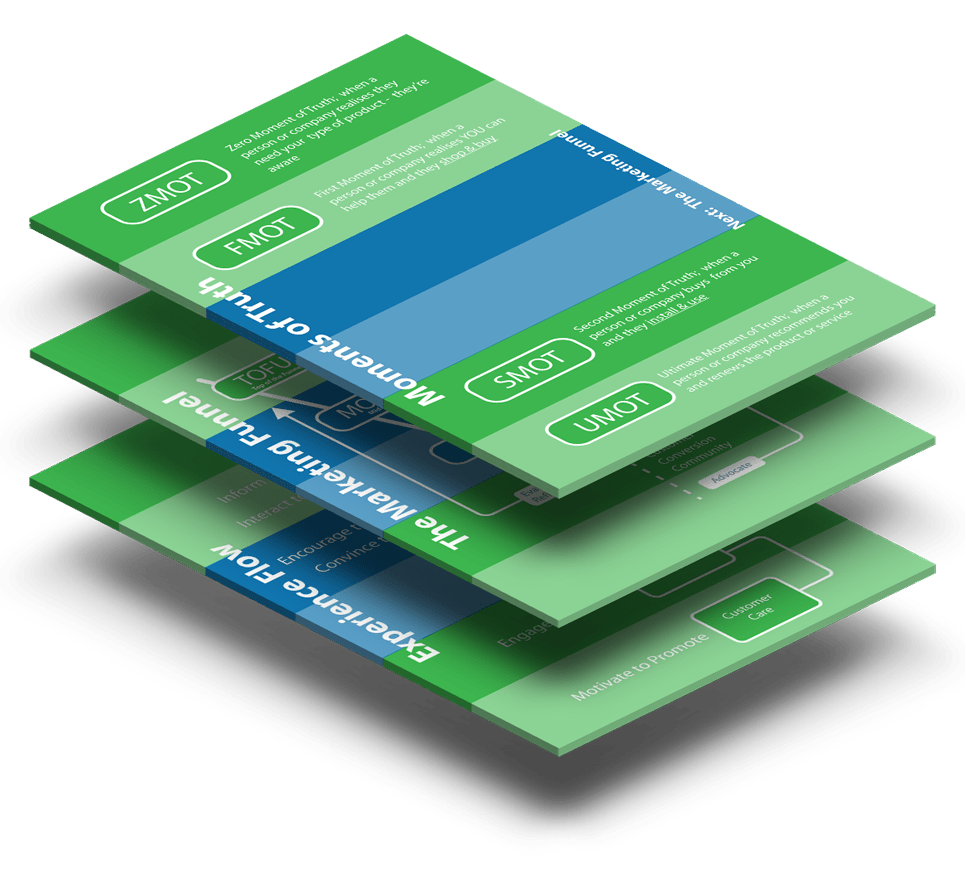
The graphics and descriptions that follow identify the processes, experiences and the technology required to make the overall strategy work — and to make it profitable.
The Digital Moments of Truth
Every touchpoint your prospect encounters forms an impression. That impression either builds confidence in you or quietly moves them towards a competitor. Most B2B businesses have no idea what their digital touchpoints actually feel like to an outside buyer, because nobody inside the business has ever walked through their own website, LinkedIn presence, or content library as a stranger would.
Digital selling addresses this directly. It replaces the assumption that a salesperson can make the first impression with the reality that your content, your visibility, and your online experience already made it — for better or worse. For more on the transformation side of this, read what businesses now expect from B2B marketers.

The Marketing Funnel
Most people in marketing know the funnel. The problem is that they focus on the funnel itself and forget that you need something to put into the top of it in the first place. Without consistent awareness activity feeding the top, the funnel sits empty and everyone panics about pipeline.
The illustration we use here is based on our own research and strategy, updated to reflect how B2B buyers actually behave — not how marketers wish they did. Take a look at The System for the full picture.

Marketing Operations
Stack the graphics on top of each other — funnel, operations, experience flow — and you can see exactly what needs to happen, in what order, from top to bottom. We have included a slideshow at the bottom of this page so you can scroll through each graphic in sequence.

Customer Experience Flow
The trigger to connect is the moment something prompts a prospect to engage with you. Those triggers are as varied as your imagination — and that is entirely the point. What matters is keeping them engaged once you have caught their attention.
From the first touch, people respond to what they see, hear and feel. That is as true for your prospects as it is for you. For some buyers, a well-produced printed brochure — spot varnish, matt laminate, something that feels considered — can do more than three follow-up calls. For others, a mobile app that keeps them updated with relevant developments does the job. There is no single correct answer. The correct answer is whatever your specific buyer actually responds to.
The Customer Experience does not stop at digital. It spans every physical element too — folders, presentations, packaging, proposals. It is the cumulative feeling of doing business with you, from first contact through to long-term account management. Get that right and you earn the UMOT: the referral. That is the most cost-effective lead generation there is.

The Technology Stack
The marketing technology landscape has become extraordinary in its scale. In 2011, there were 150 marketing technology products. By 2025, that number had grown to over 15,000. Nobody alive understands all of it. Anyone who tells you otherwise is selling something.
The practical reality is that virtually everything in a modern marketing stack is Software as a Service. That means you can build, test, swap out and scale your stack without the kind of procurement nightmares that used to define enterprise software. Integration between platforms is rarely a serious problem anymore. Zapier remains a solid option for connecting tools that do not speak to each other natively — it now supports over 7,000 apps. Make.com (formerly Integromat) is worth considering for more complex, multi-step workflows. If you have developer resource and want full data control, n8n is an increasingly popular open-source alternative. The connectors exist. The question is whether you have a clear enough strategy to know what you actually need to connect.

Technology Vendors
The vendor examples in the graphic below only scratch the surface of what is available. What matters far more than any individual tool is that your technology choices are guided by your long-term strategy — not the other way around. Pick the tactics first. The technology should serve them, not define them.
As your marketing infrastructure grows, the integration work required to keep it all functioning becomes a proper job in its own right. Think about bringing in a marketing technology specialist — a chief marketing technology officer or similar — at the right stage. It is the same logic as hiring a mechanic rather than trying to fix the car yourself every time it breaks down.

Social Media
Social media needs no introduction, but the volume of noise out there now is genuinely extreme. Most people zone out. For many, social is a break from work — a distraction, not a destination. That means the bar for getting noticed is high, and inconsistency is the fastest way to disappear entirely.
My recommendation is to build a stack of content upfront. Get thirty, sixty, ninety days worth of posts and content ready before you go anywhere near the publish button. Frequency drives visibility in every algorithm, but you can only achieve genuine frequency if you have got content ready. Doing it piecemeal means gaps, which means silence, which means nobody notices you exist. Review our full social strategy — Social 444 — for the structured approach we use.

Restructuring Content
The first practical step in applying the Moments of Truth to your business is restructuring your content. That means auditing what you have, identifying the gaps, and then converting what you know into formats that different buyers actually use — articles, podcasts, short video, longer video, live streams. The same core insight can become ten different content assets. Most B2B businesses produce one format and wonder why they are not reaching everyone.
Content also needs to be findable. That means it has to be written and structured in a way that search engines can index and surface it. Our coaching articles go deeper on this — the relationship between content structure, buyer intent, and search visibility is one of the most underinvested areas in B2B marketing.
Live Streaming Shows
A weekly live stream is one of the most underused tools available to B2B businesses. Done consistently, it builds audience, demonstrates expertise, answers the questions that buyers are already asking, and creates a library of content that compounds over time. A recording becomes a podcast episode. A podcast episode becomes a transcript. A transcript becomes an article. One live session can generate content that keeps working for months.
My recommendation is that salespeople host the show. Not marketing. Sales. The people who know what objections come up, what questions prospects actually ask, and what moves deals forward. They have a naturalness and directness in front of a camera that most polished marketing presentations lack — and buyers can tell the difference.
Digital Selling for New Business Development
Cold calling generates roughly one interested party per 400 calls — that is around five days of dialling at 75 calls per day for a single conversation that does not even guarantee a meeting. Digital selling replaces that dependency on volume and attrition with something built on visibility and pull. The technology does the reaching out. Your content does the qualifying. Your live show does the trust-building. By the time a prospect contacts you, they already know who you are.
The combination of consistent content, social media activity, a live show, and a properly structured website creates an always-on presence that cold calling simply cannot replicate. It also scales. One salesperson making 400 calls reaches a handful of distracted people. The same effort invested in building a digital presence reaches your total addressable market — repeatedly, over time, at a fraction of the cost.
We know from our own research that 95% of your market is not actively buying at any given moment. That means the only sensible strategy is to stay visible to all of them, consistently, so that when they do enter a buying cycle, you are already familiar. Digital selling is how you do that.
Key Takeaways
- Map your marketing activity against the four Moments of Truth — ZMOT to UMOT — and identify where you are absent
- Host a weekly live streaming show with a salesperson as host, not a marketer
- Build content in bulk upfront so you can maintain consistent social media frequency without scrambling
- Use digital selling to reach your total addressable market — not cold calls to a fraction of it
- Structure all content for search visibility so it works at the ZMOT stage, when buyers are researching before they ever contact you
FAQs
Q: What are the Marketing Moments of Truth?
A: They are the four critical stages where a buyer forms lasting impressions about a supplier — Zero (realising they have a need), First (noticing you), Second (buying from you), and Ultimate (recommending you). Understanding where your business shows up — or fails to — across those four stages tells you exactly where your marketing is broken.
Q: How can a B2B organisation apply the Marketing Moments of Truth?
A: Start by understanding the psychology behind each stage and where your buyers are in their decision-making before they ever contact you. Then review and implement the salesXchange System to build the visibility, content, and digital presence that puts you in front of buyers at each moment — not just when they are ready to buy.
Q: What is digital selling?
A: Digital selling is the process of using multiple digital channels — content, social media, video, live streaming, search — to engage with prospects in the format they choose, at the time they choose it. It is not about replacing salespeople. It is about making sure the technology and content do the reaching and qualifying so that salespeople spend their time on conversations that are already warm.
Q: How can businesses use live streaming to generate new business?
A: A weekly live show creates a regular touchpoint with your market — answering real questions, demonstrating expertise, and building familiarity over time. That familiarity shortens the sales cycle because when a buyer eventually makes contact, they already trust you. Have a salesperson host it. They know what buyers actually want to hear.
Conclusion
The Marketing Moments of Truth are not a marketing theory. They are a description of what buyers actually do — before, during, and after a purchase. Most B2B businesses only show up at the SMOT, when a buyer is ready to transact. Everything before that, the research, the shortlisting, the quiet comparison of suppliers, happens without them.
Digital selling is the structural answer to that problem. It gives you consistent presence at every stage of the buyer's journey — from the moment they first realise they have a problem to the moment they recommend you to someone else. It does not require a bigger team or a larger budget. It requires a clear model, the right content, and the discipline to execute it consistently. What it cannot survive is being bolted onto a strategy that is already broken.
Everything covered in this article — the stacked model, the Moments of Truth, the content strategy, the technology decisions, the live show — sits inside a single structured course built specifically to fix how B2B businesses generate new revenue. If your digital presence is not working at the ZMOT stage, buyers are eliminating you before you even know they exist. The course walks you through exactly how to change that.
The course is 20 modules, CPD certified, built on sales fact and not marketing theory. Most CEOs go through it with their VP of Sales, aligning on the diagnosis together before involving the rest of the GTM team and implementing the new strategy.
Review The Reset Today Nigel Maine is the founder of salesXchange and the architect of the sX Operating System — a B2B commercial framework built from three decades of running technology sales, not from marketing theory.
His work is grounded in a single conviction: that most B2B growth models were designed for consumer buying behaviour and have never been corrected. salesXchange exists to fix that. Nigel works directly with CEOs and commercial leadership teams across Technology, SaaS and Professional Services to rebuild their GTM infrastructure from first principles.
He is a published author, public speaker and hosts a weekly B2B live show broadcast across LinkedIn, YouTube and Facebook. Contact: 0800 970 9751 or


